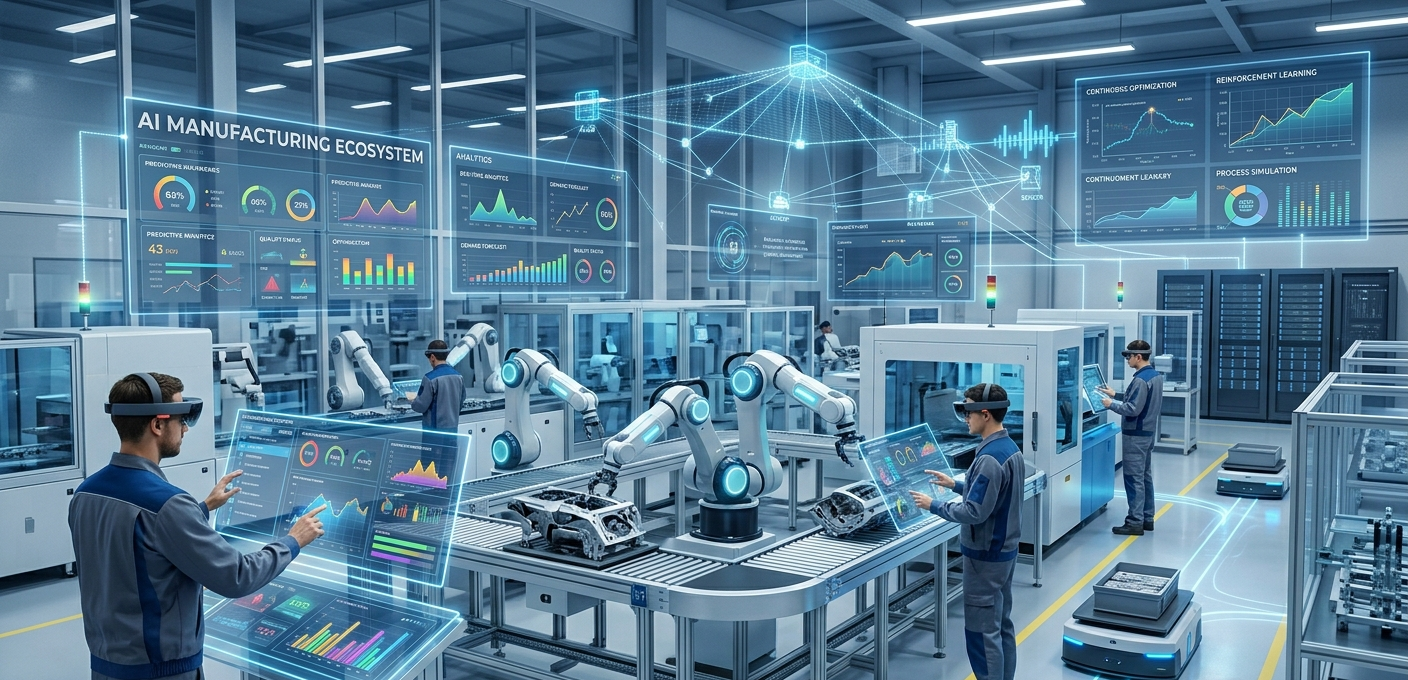
A practical guide to the concepts, use cases, and implementation strategies that every manufacturing professional — engineer, operator, or executive — needs to understand as intelligent systems reshape the factory floor.
Manufacturing has always run on data — shift reports, quality logs, machine counters. But much of this data still remains drastically underutilized. Meanwhile our ability to ingest, transform, analyze, and act on it automatically, at scale, and in real time has never been greater.
While traditional analytics has long helped organizations understand what happened, AI, machine learning (ML), and advanced analytics are enabling manufacturers to predict what will happen—and increasingly, to decide what to do about it automatically.
This article is part 2 of a 2 part series, with part 1 covering the immediate high value applications of setting up data analytics foundations. Building on the data analytics foundations discussed in part 1, this part 2 article continues this data transformation journey, outlining at how manufacturing organizations can leverage AI, Machine Learning, and Advanced Analytics in their operations.
What is AI, Machine Learning, and Advanced Analytics in Manufacturing?
While there is considerable overlap between the three and they are sometimes used interchangeably across organizations, at a high level they can each be summarized as the following:
Artificial Intelligence (AI): AI is the broad idea of making machines perform tasks that would otherwise require human intelligence — reasoning, recognizing patterns, making decisions. In a manufacturing context, AI is the umbrella: any system that senses its environment and takes intelligent action.
Machine Learning (ML): ML is a subset of AI. Instead of being explicitly programmed with rules (“if temperature > 400°F, flag fault”), an ML model learns patterns from historical data and uses those patterns to make predictions or decisions on new data. It is less about coding logical rules and more about showing a system enough examples that it figures out the rules itself.
Advanced Analytics: Advanced analytics sits somewhere between traditional business intelligence (dashboards, reports) and full ML. It includes statistical modeling, predictive modeling, simulation, and optimization — often using classical methods like regression, clustering, or linear programming. Many of the highest-ROI manufacturing applications live here.
In practice, a modern smart factory uses all three pieces simultaneously, hence their overlap. Sensors feed data into analytical pipelines, ML models flag anomalies or predict failures, and AI-powered systems close the loop by adjusting process parameters or routing work orders automatically.
Key Concepts to Understand
Before jumping into use cases, it’s critical to understand the foundational concepts that make AI, Machine Learning, and Advanced Analytics successful in manufacturing environments.
Data Foundations
Everything starts with data—and in manufacturing, that data is often complex, fragmented, and high-volume.
Sensor & IoT Data, MES, ERP: The raw signal
Temperature, pressure, vibration, flow rates — sensors generate high-frequency time-series data that is the lifeblood of predictive models. Connecting this data reliably is step one.
Preprocessing & Cleaning: Making data usable
Raw data is messy: missing values, sensor drift, duplicate readings. Preprocessing normalizes and validates this data before any model can learn from it. Garbage in, garbage out.
Feature Engineering: Signal from noise
Transforming raw inputs into meaningful signals — like rolling averages, rate-of-change metrics, or interaction terms — is often where the most analytical value is created.
These are two distinct problem types that require different approaches, yet they are often conflated. Understanding the difference is critical for scoping AI projects correctly.
Prediction vs Optimization
Prediction: What will happen?
Given current conditions, predict a future outcome — machine failure in 72 hours, demand next quarter, defect probability on the current batch.
- When will a machine fail?
- What will demand be next month?
- What will cycle time be under current conditions?
Optimization: What should we do?
Given constraints and objectives, find the best decision — optimal production schedule, ideal process parameters, best replenishment order quantity.
- What is the optimal production schedule?
- How should inventory be allocated?
- What process parameters maximize yield?
Predictive Time-Series Modeling: Patterns over time
Manufacturing data is inherently sequential. Time-series models are a specific kind of prediction model that capture trends, seasonality, and lag effects that static models miss — essential for demand and process forecasting.
- Equipment performance over time
- Demand fluctuations
- Process drift
Core AI/ML Problem Types
AI/ML covers a broad array of problem sets with different models and objectives depending on the use case at hand.
Supervised: Labeled training data
The model learns from historical examples with known outcomes — past failures labeled, defects classified.
Unsupervised: Pattern discovery
No labels required. The model finds hidden structure — clusters of similar failure modes, anomalous patterns in sensor readings that deviate from normal.
Reinforcement Learning: Learn by doing
An agent learns optimal actions through trial and feedback. Emerging for real-time process control where the environment is dynamic and complex.
Computer Vision: AI that sees
Deep learning models analyze images and video — detecting surface defects, verifying assembly steps, reading labels, and measuring dimensions at line speed.
NLP: AI that reads
Natural Language Processing extracts structured data from unstructured text — work orders, inspection reports, procurement contracts, and maintenance logs.
Model Deployment Concepts
Building a model is only half the battle—operationalizing it is where value is realized.
What Does It Mean to Deploy a Model?
Deployment means embedding a model into business processes so it can:
- Generate predictions in real time or batch
- Integrate with MES, ERP, or control systems
- Drive decisions or automation
This typically involves training and hosting a machine learning model using cloud infrastructure that integrates as a closed-loop or open-loop system (see below).
Retraining & Model Drift
Over time, models degrade due to:
- Changes in processes
- Equipment wear
- Shifts in demand or inputs
This is known as model drift, and it requires ongoing monitoring and retraining.
Cloud vs. Edge ML Ops
- Cloud: Centralized, scalable, ideal for low cost heavy computation.
- Edge: Runs directly on machines or local devices for low-latency decisions.
A hybrid approach is sometimes used to leverage the superior compute and pricing of cloud while achieving the latency benefits of edge computing.
Closed-Loop vs. Open-Loop Systems
- Open-loop: Model provides recommendations, humans act
- Closed-loop: Model outputs directly trigger automated actions
Closed-loop systems unlock the highest value—but require trust, governance, and reliability.
Top Use Cases of AI, Machine Learning & Advanced Analytics in Manufacturing
1. Production & Equipment
- Predictive Maintenance (ML) — Analyze sensor data to predict equipment failures before they happen, reducing unplanned downtime and extending asset life. One of the most mature and widely deployed manufacturing AI applications.
- Production Scheduling Optimization (AI/ML) — Optimize sequencing and resource allocation across lines, shifts, and facilities to maximize throughput while meeting delivery commitments.
- Process Optimization (AI/ML) — Continuously tune process parameters — temperatures, speeds, pressures, feed rates — to maximize output quality and minimize waste. Often implemented as a closed-loop control system.
- Throughput & Cycle Time Prediction (ML) — Predict production rates and cycle times under varying conditions to improve planning accuracy and identify bottlenecks proactively.
- Energy Optimization (AI/ML) — Model energy consumption patterns and optimize machine scheduling, setpoints, and load shifting to reduce energy costs without sacrificing throughput.
2. Quality & Defects
- Visual Inspection & Defect Detection (Computer Vision) — Deploy camera-based AI systems to inspect products at line speed — detecting surface defects, dimensional deviations, and assembly errors with greater consistency and speed than human inspectors.
- Root Cause Analysis (Advanced Analytics/ML) — When quality events occur, ML can rapidly surface the most likely causal factors from thousands of process variables — reducing the time to resolution from weeks to hours.
- Anomaly Detection (ML) — Continuously monitor process and sensor data to flag deviations from normal operating conditions before they escalate into defects or failures.
- Yield & Scrap Optimization (AI/ML) — Model the relationships between input variables and yield outcomes to identify the process conditions that maximize first-pass yield and minimize scrap.
- Statistical Process Control Enhancement (Advanced Analytics) — Move beyond static SPC rules with adaptive control limits and multivariate monitoring that accounts for complex process interactions and changing baselines.
3. Supply Chain & Planning
- Demand Forecasting (ML) — Replace static statistical forecasts with ML models that incorporate external signals — macroeconomic indicators, weather, seasonality, promotions — for more accurate demand predictions across SKUs and horizons.
- Inventory & Warehouse Optimization (AI/ML) — Dynamically optimize safety stock levels, reorder points, and warehouse slotting based on demand variability, lead time uncertainty, and service level targets.
- Procurement & Spend Analytics (NLP/ML) — Use NLP to automatically classify and categorize spend data, forecast commodity prices, and monitor contract compliance — converting messy procurement data into strategic insight.
- S&OP Enhancement (AI/ML) — Integrate ML-driven demand forecasts into the S&OP process with automated consensus forecasting, scenario simulation for capacity and inventory decisions, and AI-powered balancing of demand and supply signals across functions.
4. Business & Insights
- Dynamic Pricing (AI/ML) — Model price-demand elasticity and market conditions to recommend optimal pricing in real time, balancing volume, margin, and competitive positioning.
- Profitability Optimization (AI/ML) — Optimize product mix, production allocation, and pricing decisions simultaneously to maximize contribution margin across a complex portfolio of products and customers.
- Document & Compliance Automation (NLP) — Use NLP to extract structured data from technical documents, work orders, and inspection reports; automate quality report generation; and monitor regulatory compliance with full audit trail automation — dramatically reducing manual administrative burden.
5. Advanced & Emerging Use Cases
- Reinforcement Learning for Process Control: RL agents learn optimal control strategies through continuous interaction with the production environment — handling complex, dynamic processes that defeat traditional PID controllers.
- Self-Optimizing Factories: Fully integrated AI systems that autonomously optimize operations end-to-end — coordinating scheduling, quality, energy, and supply chain in real time without human intervention.
- Closed-Loop Optimization Systems: The convergence of prediction, optimization, and automation into continuous improvement loops — where every cycle makes the system smarter and operations incrementally better.
Looking Ahead
The use cases mentioned here outline just a few potential applications of AI in manufacturing. With an understanding of the core concepts and solid data fundamentals, the opportunities are vast and ever-expanding with the progression of technology. The important piece is to start with the business objectives and build you AI systems on top of a solid foundation of clean, reliable data.
Where to Get Started
Before any AI or ML project can succeed, a solid data foundation must be in place. If your organization is still working from fragmented data sources, inconsistent data definitions, or limited sensor coverage, that is the place to begin. Our part 1 of this two part series that covers the foundations of data analytics in manufacturing walks through the foundational steps every manufacturer should take before deploying predictive models.
Once your data foundation is established, the first practical implementation step is typically a focused pilot: one problem, one dataset, one clear metric of success. A well-scoped pilot builds organizational confidence, surfaces the real-world data challenges you’ll need to solve, and delivers demonstrable ROI that funds the next phase.
After the successful pilot comes the operationalization of the model and further integration into the operations. From there you have a roadmap for how to deploy AI & Advanced analytics into your manufacturing operations.
Implementing AI, ML & Advanced Analytics with Lasso Manufacturing Analytics Consulting
At Lasso Manufacturing Analytics Consulting, we specialize in helping manufacturers bridge the gap between data and results. We don’t just build models—we ensure they deliver sustainable value on the shop floor.
Our approach starts with your business priorities, audits your data landscape, and designs tailored solutions across predictive maintenance, quality AI, process optimization, and supply chain intelligence. From edge deployments for real-time control to cloud-scale analytics for strategic planning, we handle the full lifecycle: data strategy, cloud infrastructure, model development, MLOps, change management, and ongoing optimization.
Ready to turn your factory data into a competitive advantage? Contact Lasso today to discuss how AI, ML, and advanced analytics can transform your operations.