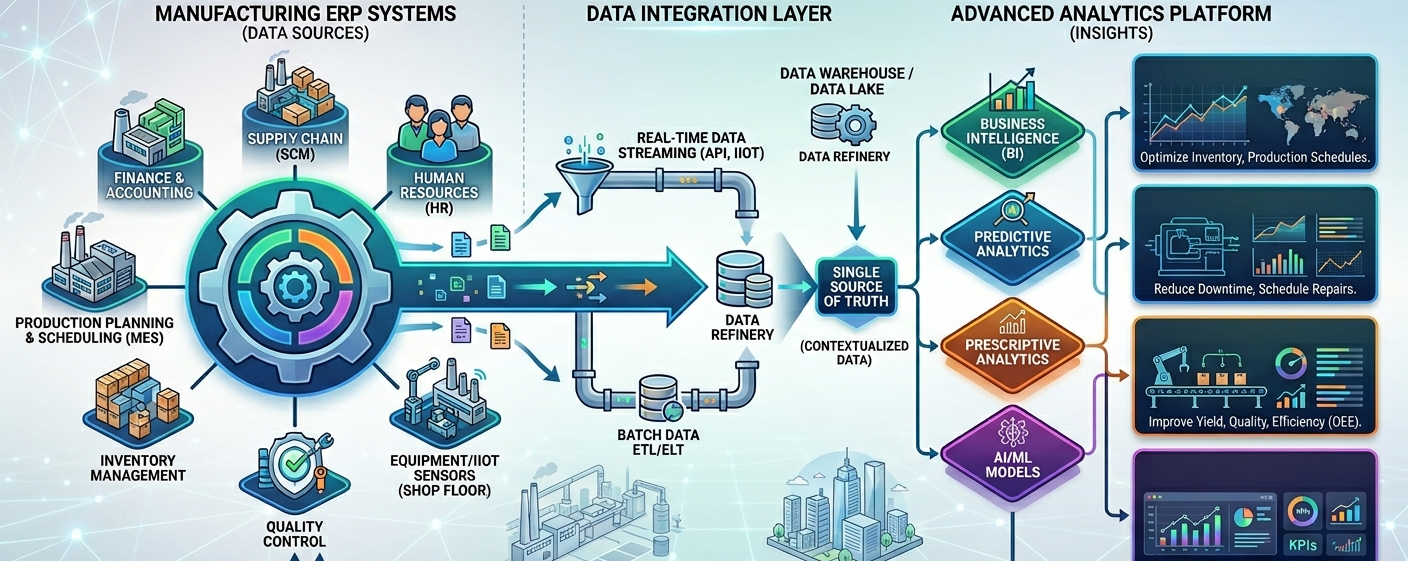
Most manufacturers we talk to have the same story. They invested heavily in an ERP — SAP, Oracle, Infor, whatever the platform — and were told it would give them visibility into their operations. And in some sense, it does. There are dashboards. There are reports. There’s a production order summary, an inventory aging report, a variance report that finance reviews every month.
But when the plant manager wants to know why a specific line has been running at 73% OEE for the past six weeks, or when procurement needs to understand how supplier lead time variability is cascading into schedule attainment, the ERP’s standard reporting hits a wall. Fast.
That wall is what we spend most of our time helping clients break through.
The Standard Report Problem
Standard ERP reports were designed for compliance and record-keeping, not for operational decision-making. They answer questions that were anticipated at implementation time — not the questions that emerge as your business evolves, your product mix shifts, or your supply chain grows more complex.
The deeper issue is structural. ERP data models are built around transactions: purchase orders, work orders, goods receipts, invoices. Each transaction is captured correctly. But the relationships between transactions — the causal chains, the timing dependencies, the cross-functional patterns — are rarely surfaced by out-of-the-box reports.
You can pull a work order completion report. You can pull a material consumption report. Connecting them to understand whether a specific raw material lot is correlated with elevated scrap rates on a particular machine? That’s not a standard report. That’s an analytical question, and it requires a fundamentally different approach to how you extract, model, and present ERP data.
What Real Integration Actually Requires
When we build analytics solutions on top of ERP systems, there are several layers that standard reporting never touches.
1. Data extraction that goes beyond the reporting layer
Most ERP reporting tools query views or cubes that the vendor has pre-built. These are convenient, but they’re filtered, aggregated, and structured for the vendor’s assumptions about what you need. Real integration means going deeper — extracting from the transactional tables directly, capturing change data incrementally, and pulling from modules that rarely get integrated: quality management, plant maintenance, production scheduling, and HR/labor modules that live alongside the core financials.
This is technically demanding work. It requires understanding the ERP’s underlying schema, handling the quirks of how different plants or business units configured the system differently, and building extraction pipelines that can handle the data volumes manufacturing environments produce.
2. A purpose-built manufacturing data model
Raw ERP data doesn’t arrive analysis-ready. Work orders get split, revised, and partially confirmed. Materials get moved between storage locations in ways that obscure actual consumption. Shift records overlap with order timestamps in ways that make labor attribution non-trivial.
Building a real analytics layer means constructing a semantic model that translates ERP logic into manufacturing concepts: production runs, yield events, downtime episodes, inventory turns by SKU and location, supplier performance by commodity and site. This model becomes the analytical foundation that everyone — from plant floor supervisors to supply chain directors to the CFO — can query against in a consistent way.
3. Time-series thinking, not snapshot thinking
ERP reports are usually point-in-time or period summaries. Analytics that actually drive decisions need to track how things change over time. Is OEE trending up or down on this asset over the past 90 days? How has first-pass yield responded since we changed the process parameters in March? Is the gap between planned and actual schedule attainment widening or narrowing after the last planning cycle adjustment?
This requires storing historical snapshots of ERP state — something most ERP systems themselves don’t make easy — and structuring your data warehouse to support time-series queries efficiently.
4. Cross-domain integration
The most valuable insights in manufacturing almost always live at the intersection of domains. ERP data on its own can tell you a lot. But when you join ERP production data with quality system inspection results, MES machine data, and supplier portal lead time actuals, you start to answer questions that no single system could answer alone.
For example: correlating raw material certificate-of-analysis values (from quality) with finished goods first-pass yield (from the ERP work order) and specific equipment behavior (from MES) is how you stop chasing scrap reactively and start predicting and preventing it. That kind of analysis requires integration work that goes well beyond what ERP vendors scope in their standard reporting packages.
What This Looks Like in Practice
Here’s a concrete illustration. A mid-sized discrete manufacturer we work with had a chronic schedule attainment problem. Their ERP was generating production schedules, and they had standard reports showing planned vs. actual completions by week. The reports confirmed the problem — attainment was hovering around 68% — but gave them no traction on the cause.
When we built out a proper analytics layer, we extracted detailed work order history (not just completion records, but every status transition and timestamp), material availability events, machine downtime records from maintenance, and labor hour logs. We built a model that let us trace each late order back to its earliest deviation point — the moment where the actual execution diverged from the plan.
What emerged was clear: roughly 55% of the attainment failures traced back to material availability issues that were visible in the ERP data days before they impacted production — they just weren’t being surfaced to anyone in time to act. Another 30% were driven by two specific work centers that had elevated unplanned downtime rates on certain day shifts. None of this was in a standard report. All of it was in the data.
That’s the difference between reporting on what happened and understanding why it happened and what to do about it.
The Organizational Side of the Equation
Real ERP-to-analytics integration isn’t just a technical project. It changes how decisions get made and who gets to make them.
When plant supervisors have access to their own shift-level performance dashboards — instead of waiting for a weekly report from a central analyst — they start asking different questions and making faster adjustments. When supply chain teams can see supplier delivery performance trends self-service, rather than requesting a custom pull from IT, procurement conversations with suppliers become more concrete and more frequent.
This shift in data access and decision-making cadence is often more valuable than any individual insight the analytics produces. It builds organizational muscles for using data operationally, not just for monthly reviews.
What to Look for When Evaluating Integration Approaches
If you’re assessing whether an analytics initiative will actually deliver beyond standard ERP reports, here are the questions that matter:
Are we accessing source tables or pre-built views? Pre-built views are faster to start with but will limit you. Eventually, you’ll hit a question the view wasn’t designed to answer.
Do we have a manufacturing-specific semantic layer? A generic BI tool sitting on raw ERP data is not the same as a model built around your actual production constructs and terminology.
Can we support historical trend analysis, not just current snapshots? If your data warehouse only holds the current state of ERP records, you’ve lost the ability to ask how things have changed over time.
Are we integrating across systems, or just reporting from one? The most powerful analyses almost always cross system boundaries. Quality, maintenance, scheduling, labor, and supply chain data all need to be in scope eventually.
Is the analytics designed for operational users, not just analysts? If the output requires a trained analyst to interpret and distribute, you haven’t yet built an analytics capability — you’ve just built a faster way to produce reports.
Closing Thought
The goal of real ERP-to-analytics integration isn’t to produce more reports. It’s to give the people making decisions — on the plant floor, in supply chain, in operations leadership — the clarity and speed they need to act with confidence.
Standard reports tell you what your ERP recorded. A real analytics capability tells you what your operations are doing, why, and what’s likely to happen next if you don’t change course.
That’s a different product entirely. And for manufacturers competing on efficiency, reliability, and margin in a market that won’t slow down for anyone, it’s increasingly the difference between leading and lagging.