If you’ve ever tried to build a meaningful KPI report from raw machine data and found yourself drowning in duplicate sensor readings, mismatched timestamps, and unit inconsistencies, you already understand the problem this article is about.
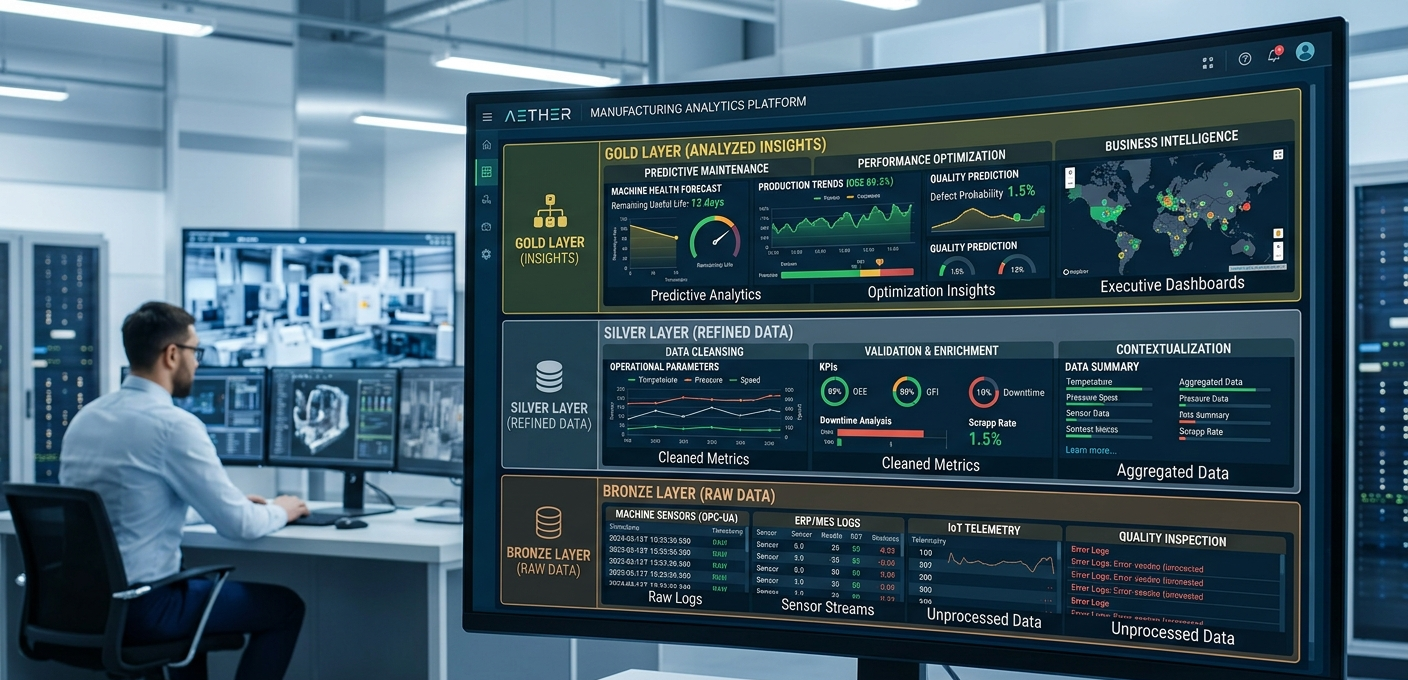
In manufacturing analytics, data doesn’t arrive clean. It arrives fast, noisy, and in formats that were designed for machines to write — not for humans or analytics systems to read. The medallion architecture — commonly called the Bronze / Silver / Gold layering model — is the structural answer to that reality. It’s a framework for organizing how raw data flows through your analytics environment until it becomes a trusted, decision-ready asset.
Let’s walk through each layer and, more importantly, what it means in a manufacturing context.
The Core Idea: Data Gets Better as It Moves
The medallion model describes a pipeline with three progressive stages of data quality. Each stage has a distinct purpose, audience, and set of rules. Think of it like a refinery: raw ore goes in one end, and refined, usable metal comes out the other. The analogy isn’t accidental — the names Bronze, Silver, and Gold reflect exactly that progression.
Bronze: Raw, Unmodified, Preserved
The Bronze layer is your source-of-truth archive. Data lands here exactly as it was received — no transformations, no corrections, no filtering. If a PLC sent a malformed packet at 3:47 AM, that malformed packet lives in Bronze. If an OEE system exported a CSV with a column in the wrong format, that CSV exists in Bronze as-is.
In a manufacturing context, Bronze typically includes:
- Raw SCADA and historian exports (OSIsoft PI, Ignition, Wonderware)
- Machine sensor data at full resolution — sometimes thousands of data points per second
- ERP transaction logs from SAP, Oracle, or Epicor
- Quality system records from LIMS or MES
- Shift reports, downtime logs, and maintenance tickets in their original formats
The Bronze layer is not for querying in production dashboards. Its purpose is auditability and replayability. If an analyst makes a mistake in a downstream transformation two years from now, you can always re-derive the corrected dataset from Bronze without going back to source systems that may no longer exist or may have changed.
The governing principle of Bronze: Never delete, never modify. Only append.
Silver: Cleaned, Conformed, Trustworthy
Silver is where the real engineering work happens. Data from Bronze is validated, cleaned, standardized, and joined into a coherent structure. This is where a manufacturing analytics team spends the most time, and where the most value is created — even if it’s invisible to end users.
Silver-layer transformations in manufacturing typically include:
- Unit normalization: Converting all temperature readings to Celsius, all pressures to bar, all throughput metrics to units-per-hour — regardless of what the source system used.
- Timestamp alignment: Reconciling time zones across facilities, correcting clock drift from edge devices, and aligning data from systems that log at different cadences.
- Deduplication: Removing duplicate sensor readings caused by network retries or buffering failures.
- Schema enforcement: Ensuring that “machine_id” means the same thing across your MES, your ERP, and your historian — and that they all resolve to the same master equipment list.
- Null and outlier handling: Flagging or imputing missing values from sensor dropout events, and tagging physically impossible readings (a temperature of -999°C is a sensor fault, not a data point).
- Entity resolution: Matching part numbers, work order IDs, and operator IDs across systems that were never designed to speak to each other.
Silver data is suitable for analysts and data scientists. It’s clean enough to run exploratory analysis on, build ML models against, and use as input to operational reporting. It is not yet shaped for a specific business question — it’s a general-purpose, trustworthy foundation.
The governing principle of Silver: Conform and trust. If it’s in Silver, it’s been validated.
Gold: Aggregated, Business-Ready, Decision-Facing
Gold is where data gets shaped for consumption. It is purpose-built for specific business questions, roles, and decisions. Gold tables and datasets are typically pre-aggregated, pre-joined, and pre-filtered so that dashboards and reports can render quickly and consistently.
In manufacturing analytics, Gold assets look like:
- OEE dashboards: Availability, Performance, and Quality rolled up by line, shift, and week — derived from Silver-layer machine and production data.
- Downtime Pareto reports: Downtime minutes by cause code, aggregated at the equipment group level, ready for a daily operations review.
- Yield trend tables: First-pass yield by product family and production cell, with week-over-week comparison built in.
- Supplier quality scorecards: Incoming inspection results joined with supplier master data, summarized for procurement review meetings.
- Energy intensity metrics: kWh per unit produced, broken down by asset and shift, ready for sustainability reporting.
Gold layer datasets are typically maintained by the analytics team but owned by the business. A production manager consuming a Gold-layer OEE report doesn’t need to know anything about the Bronze or Silver layers. The data simply arrives — clean, fast, and correct.
The governing principle of Gold: Purpose-built for the decision. Optimized for the consumer.
Why This Matters in Manufacturing
Many industries can tolerate some looseness in their data architecture. Manufacturing cannot. The consequences of acting on bad data in a production environment are immediate and expensive: wrong inventory decisions, undetected quality escapes, maintenance crews dispatched to the wrong asset, downtime misattributed to the wrong cause.
The medallion architecture enforces discipline at the right layers. It makes clear who is responsible for data quality at each stage, what transformations have been applied, and when data can be trusted for a given purpose.
It also enables something manufacturers increasingly need: historical replay. When process parameters change, when a new product is introduced, or when a quality escape requires root cause investigation reaching back 18 months, a properly maintained Bronze layer means you can re-run your Silver and Gold transformations against historical data with today’s logic. Without that foundation, investigations stall and institutional knowledge walks out the door with the engineer who built the original query.
Common Mistakes We See in the Field
After working across dozens of manufacturing environments, we’ve observed a few patterns that consistently undermine the value of this architecture:
Skipping Silver entirely. Teams eager to get to dashboards often push raw Bronze data directly into Gold-layer reports. This works until it doesn’t — typically the moment two source systems disagree and no one can explain which one is right.
Letting Gold drift from the business. Gold datasets built for a question that no longer gets asked become technical debt. Gold should be treated like a product: versioned, documented, and retired when it’s no longer serving a decision.
Not governing Bronze ingestion. If data teams feel free to clean Bronze as it arrives, the auditability guarantee disappears. Ingestion to Bronze must be as close to pass-through as possible.
Treating all data at the same latency. Not every layer needs to be real-time. Bronze might need near-real-time ingestion for sensor data, but Gold dashboards for weekly OEE reviews can be batch-refreshed nightly. Matching latency to business need is how you avoid over-engineering.
Getting Started
If your organization is still working from a single undifferentiated data lake — or worse, directly from source system exports — the path to a medallion architecture doesn’t have to be a multi-year program. Start by identifying your one or two highest-stakes reporting use cases, trace the data lineage from source to dashboard, and draw the Bronze / Silver / Gold boundaries explicitly.
In our experience, the act of drawing those boundaries — even on a whiteboard — surfaces more about your data quality and governance gaps than any audit tool can.
The goal isn’t architectural elegance for its own sake. The goal is that when a plant manager asks why yield dropped on Line 4 last Tuesday, your team can answer in minutes, with confidence, and show their work.
That’s what a well-built medallion architecture makes possible.
Lasso partners with manufacturers to design, build, and operationalize analytics infrastructure — from data architecture to frontline decision tools. If you’re evaluating your current data foundation, we’d welcome the conversation.