Every manufacturer is sitting on a gold mine of data — shift logs, machine telemetry, quality inspection records, supplier lead times, energy consumption by line. The challenge has never been generating data. The challenge is turning it into decisions fast enough to matter.
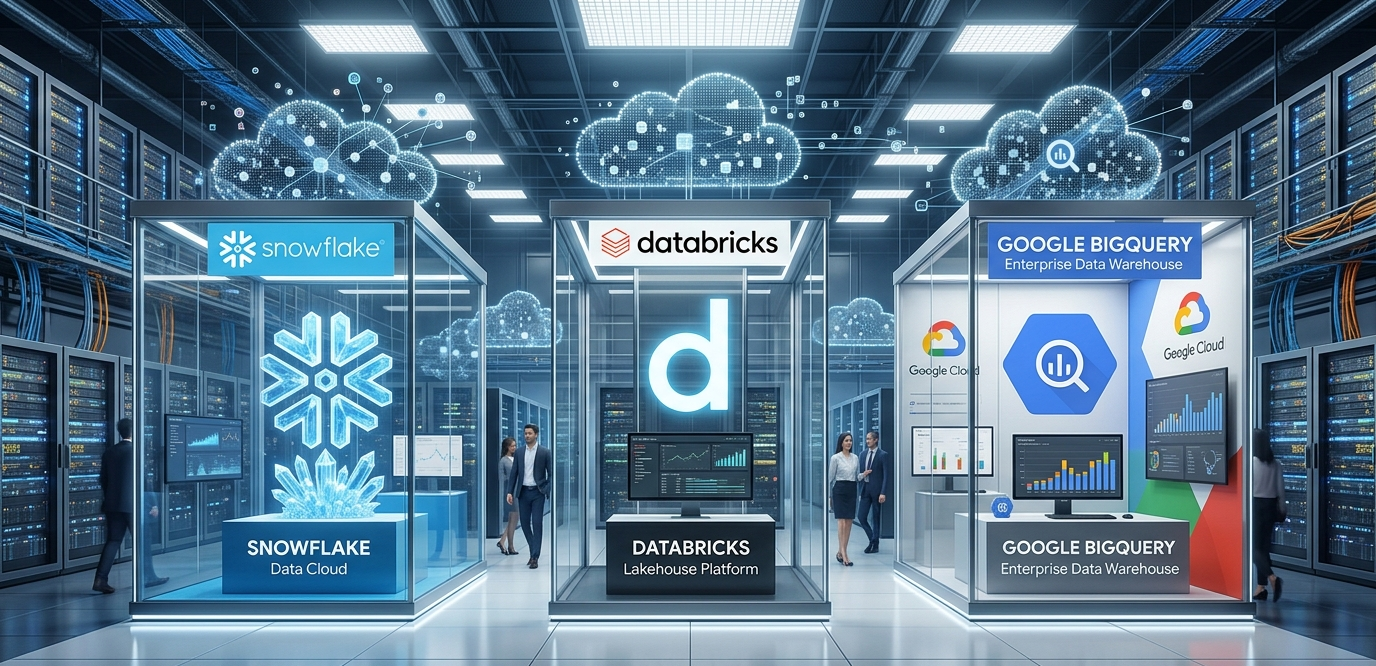
Over the past five years, three platforms have emerged as the cloud data warehouse choices for industrial enterprises: Snowflake, Databricks, and Google BigQuery. Each has genuine strengths. Each has real blind spots. And the wrong choice — or an undifferentiated one — will cost you years of technical debt and millions in rework.
This article cuts through vendor marketing to give you what our clients actually need: a grounded, manufacturing-specific read on how these platforms perform where it counts.
The Manufacturing Data Problem Is Different
Before evaluating any platform, acknowledge the peculiarity of manufacturing data. Unlike retail or financial services, manufacturers deal with data that is simultaneously high-frequency and high-stakes. A vibration sensor on a CNC spindle might produce 10,000 readings per second. A failed weld on an automotive body panel might not surface until final inspection — or worse, after delivery.
This creates a data architecture tension that pure-play analytics vendors often don’t fully appreciate: you need the operational precision of a time-series database, the analytical depth of a warehouse, and the machine learning infrastructure of a data science platform — ideally in the same stack, under the same governance model.
None of the three platforms solves this perfectly. The question is which one covers your specific gap most effectively.
Snowflake: The Governance Champion
What it does well in manufacturing
Snowflake’s core value proposition is clean: separate compute from storage, pay for what you use, and run SQL against structured data with enterprise-grade access control. For manufacturers with complex organizational structures — multiple plants, JV partners, external suppliers, regulatory auditors — Snowflake’s data sharing and governance model is genuinely best-in-class.
The platform’s Secure Data Sharing feature allows a manufacturer to give a Tier-1 supplier read-only access to their relevant demand forecast data without copying it, without building a custom API, and without creating a governance nightmare. That’s a real capability that solves a real problem in supply chain visibility.
Snowflake’s support for semi-structured data (JSON, Avro, Parquet) also means it can ingest machine data from industrial IoT platforms without forcing a rigid schema upfront — a practical necessity when integrating legacy PLC outputs alongside modern SCADA systems.
Where manufacturers run into friction
Snowflake is not a machine learning platform. It has ML capabilities through Snowpark and partnerships, but teams that want to train models on sensor data, build anomaly detection pipelines, or operationalize predictive maintenance algorithms will find themselves fighting the tool. The Snowpark ML layer is improving but still trails Databricks significantly for iterative model development.
Streaming is also an afterthought. Snowflake’s native streaming ingestion through Snowpipe is useful for near-real-time, but it was designed for event logs, not 100ms machine telemetry. For manufacturers who need true real-time decision-making at the edge, Snowflake typically becomes the downstream analytical layer, not the operational system.
Finally, cost management requires discipline. Snowflake’s credit-based model is transparent but can escalate quickly when analysts run exploratory queries on multi-year production history without warehouse limits in place. We’ve seen manufacturers receive bill shock in their first quarter — almost always due to inadequate query governance, not platform failure.
Databricks: The ML Engineering Powerhouse
What it does well in manufacturing
If Snowflake is the platform for the data governance team, Databricks is the platform for the data science team. Built on Apache Spark and Delta Lake, it’s the dominant choice for organizations that treat machine learning as a core capability rather than an experiment.
For manufacturing use cases, this matters enormously. Predictive maintenance on rotating equipment, computer vision for inline defect detection, generative AI for process parameter optimization — these are not BI dashboard problems. They require iterative model training, feature engineering pipelines, and MLflow-based experiment tracking. Databricks handles all of this natively and at scale.
The Unity Catalog, Databricks’ governance layer, has matured significantly and now rivals Snowflake’s access control capabilities for most enterprise requirements. And the Lakehouse architecture — storing data in open formats (Delta Lake) on cloud object storage — means you’re not locked into proprietary formats that complicate future migrations.
For manufacturers dealing with time-series sensor data, Databricks’ streaming capabilities through Structured Streaming are genuinely production-grade. One automotive OEM we work with runs continuous anomaly detection on 40,000 sensors across three plants, with model inference latency under two seconds — that’s a Databricks use case, not a Snowflake one.
Where manufacturers run into friction
Databricks has a steep organizational learning curve. It’s an engineering platform, and using it well requires data engineers who understand distributed computing, cluster management, and Delta Lake internals. Manufacturers with small analytics teams or SQL-first cultures often underestimate this investment and end up with expensive, underutilized clusters.
The BI and reporting experience is also weaker than alternatives. While Databricks SQL has improved, analysts accustomed to seamless Tableau or Power BI integration often find the workflow less smooth than Snowflake or BigQuery. For manufacturers whose downstream consumers are plant managers in Excel, not data scientists in notebooks, this is a real friction point.
Lastly, cost governance on Databricks is complex. Cluster autoscaling is powerful but can be unpredictable. Without mature FinOps practices in place, engineering teams optimizing for performance can inadvertently generate substantial compute bills.
BigQuery: The Serverless Pragmatist
What it does well in manufacturing
Google BigQuery’s defining characteristic is its serverless model: there are no clusters to manage, no concurrency limits to configure, no infrastructure to right-size. You load data, run a query, and pay for the bytes scanned. For manufacturing organizations with small or overburdened IT teams, this operational simplicity is a genuine competitive advantage.
BigQuery’s query performance at scale is exceptional. Petabyte-scale analytical queries that would take hours in a traditional data warehouse run in seconds, thanks to Dremel’s columnar architecture and Google’s underlying infrastructure. For manufacturers doing historical production analysis — tracing a quality anomaly across two years of shift data from 15 lines — BigQuery’s raw speed is hard to match.
The GCP ecosystem integration is also a major draw for manufacturers already invested in Google Cloud. BigQuery connects natively with Pub/Sub for streaming ingestion, Vertex AI for ML, Looker for BI, and Google Workspace for operational reporting. If your ERP, MES, or historian already pushes data to GCP, BigQuery is often the path of least resistance.
BigQuery ML, while not as capable as Databricks for complex model training, allows analysts to train and deploy regression, classification, and time-series models directly in SQL — lowering the barrier for plant-level analysts to do basic predictive work without a dedicated data science team.
Where manufacturers run into friction
BigQuery’s cost model, while simple, can be surprising. The on-demand pricing model charges per terabyte scanned, meaning a single runaway query against an unpartitioned table can cost hundreds of dollars. Manufacturers with large, unstructured production data sets need disciplined partitioning and clustering strategies from day one — this is not optional.
Egress costs are also a consideration. Moving data out of BigQuery to non-GCP systems incurs Google’s standard egress fees, which can become significant for manufacturers with hybrid or multi-cloud architectures that need data in multiple places.
For complex ML use cases, BigQuery ML’s breadth still lags Databricks. And for organizations heavily invested in Azure or AWS infrastructure, BigQuery requires running a GCP island within a larger non-Google estate — an architectural complexity that adds management overhead.
Head-to-Head: What Actually Matters on the Shop Floor
| Capability | Snowflake | Databricks | BigQuery |
|---|---|---|---|
| Real-time sensor ingestion | Snowpipe (near-real-time); limited | Structured Streaming; production-grade | Pub/Sub integration; strong |
| Predictive maintenance ML | Snowpark ML; requires effort | Native; best-in-class MLflow + Spark | BigQuery ML; SQL-accessible, limited depth |
| Multi-plant data governance | Best-in-class secure sharing | Unity Catalog; strong | Column-level security; adequate |
| BI & reporting integration | Excellent (Tableau, Power BI, Sigma) | Good (Databricks SQL improving) | Excellent (Looker, native GCP) |
| Time-series / historian data | Semi-structured support; manageable | Delta Lake time-travel; strong | Partitioned tables; good at scale |
| Operator-level SQL accessibility | Strong; concurrency isolation | Moderate; Databricks SQL layer | Strong; serverless, no contention |
| Infrastructure management burden | Low (managed warehouse sizing) | High (cluster management required) | Very low (fully serverless) |
| Vendor lock-in risk | Moderate (proprietary formats) | Low (open Delta Lake, portable ML) | Moderate (GCP ecosystem coupling) |
| Cost model clarity | Credit-based; requires governance | Compute-based; complex to optimize | Per-TB scanned; predictable with partitioning |
The Questions You Need to Answer Before Choosing
We’ve seen too many platform decisions driven by analyst preference, vendor relationships, or whatever the CDO used at their last company. Here are the questions that actually determine the right answer for a manufacturer:
Where does your data live today, and how messy is it? If you’re pulling from 15-year-old OSIsoft historians, ERP extracts in flat files, and custom Python scrapers off legacy PLCs, you need a platform that can handle transformation complexity — and that points toward Databricks. If your data is relatively clean and already flowing through modern APIs, Snowflake or BigQuery become viable.
Who is your primary user persona? Continuous improvement engineers running SQL queries against process data are a different user than data scientists building production ML models. The former points toward Snowflake or BigQuery; the latter toward Databricks. Don’t optimize for the wrong user.
Is ML a roadmap item or a current capability gap? If you’re funding a predictive quality or OEE optimization initiative in the next 12 months, start with Databricks. Building ML on top of Snowflake or BigQuery later is painful migration work you can avoid.
What does your cloud commitment look like? If you’re AWS-native, Snowflake’s multi-cloud flexibility is an advantage. If you’re all-in on Azure, Databricks integrates natively. If you’re GCP-first, BigQuery is almost certainly the answer.
What’s your team’s maturity level? This is the question clients least want to answer honestly. A sophisticated data engineering team can extract value from any of these platforms. A team of three analysts who are strong in SQL and weak in distributed systems will struggle with Databricks regardless of how powerful it is. Choose the platform your current team can actually operate, then build toward your aspirations.
The Platform Is Not the Strategy
A word of caution before you take this comparison directly into a vendor selection meeting: the platform choice matters less than you think, and the operating model matters more than you think.
We’ve seen manufacturers on Snowflake generate breakthrough yield improvements. We’ve seen manufacturers on Databricks generate nothing but impressive architecture diagrams. The platform is infrastructure. What drives manufacturing outcomes is the organizational capability to ask the right questions, build the right data products, and actually change what happens on the line based on what the data says.
Before you spend six months evaluating platforms, spend six weeks understanding your highest-value analytics use cases, the quality of your underlying data, and the realistic capability of the team who will operate whatever you choose. That exercise will make your platform decision obvious — and will prevent you from spending the next two years explaining to your CFO why the data lake you built isn’t translating into margin improvement.
The right cloud data warehouse is the one that gets used. Choose accordingly.