The Analytics Hierarchy — And Why Most Manufacturers Are Stuck at the Wrong Level
Walk into most manufacturing operations today and you’ll find dashboards everywhere. Screens showing OEE percentages, yield rates, downtime trends, rejection counts. In more sophisticated plants, you’ll find predictive models alerting maintenance teams to equipment that’s likely to fail in the next 72 hours.
These are genuine achievements. But they share a common limitation: they tell you what happened or what might happen. They don’t tell you what to do about it.
That’s the gap prescriptive analytics fills — and closing it is where we see the most transformative ROI in manufacturing today.
What Prescriptive Analytics Actually Means
The analytics maturity model is well-established:
- Descriptive analytics answers: What happened? (dashboards, reports, KPIs)
- Diagnostic analytics answers: Why did it happen? (root cause analysis, drill-downs)
- Predictive analytics answers: What will happen? (forecasting, failure prediction)
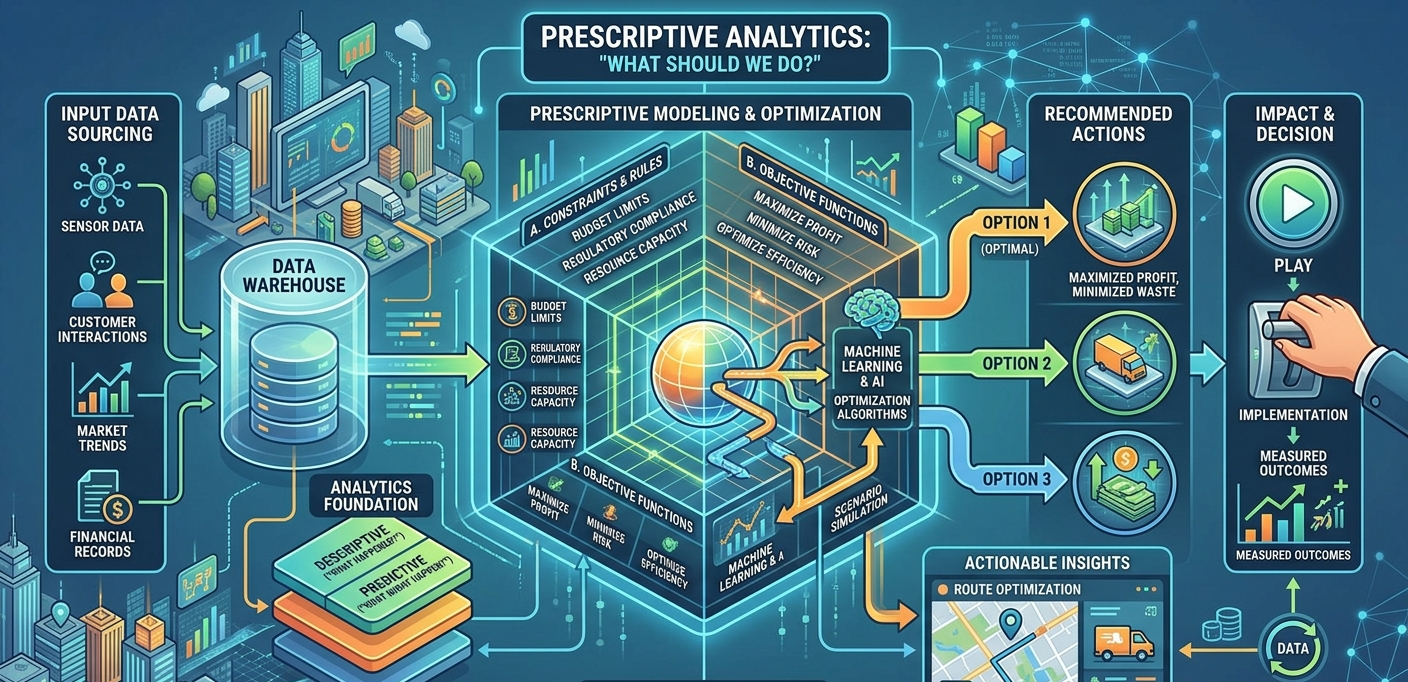
- Prescriptive analytics answers: What should we do? (optimization, recommended actions)
Prescriptive analytics combines predictive models, optimization algorithms, and business constraints to generate specific, actionable recommendations. It doesn’t just flag a problem — it tells operators and planners the best course of action given all relevant variables simultaneously.
For manufacturers, this distinction is enormous. A predictive model might tell you that Line 3’s primary drive has a 78% probability of failure within the next 96 hours. A prescriptive system takes that signal and tells you: Schedule maintenance on Line 3 during the Tuesday night shift. Reroute Tuesday’s production volume to Lines 1 and 4 using this specific allocation. Pre-order part SKU-7741 from Supplier B, not Supplier A, to avoid the 3-day lead time gap.
That’s not a subtle improvement — that’s the difference between an alert and a decision.
The Three Engines of Prescriptive Analytics
Prescriptive systems in manufacturing are typically built on three interlocking components:
1. Optimization Engines
Mathematical optimization — linear programming, mixed-integer programming, stochastic optimization — sits at the core of most prescriptive systems. These algorithms evaluate enormous solution spaces to find the optimal course of action given defined objectives and constraints.
In production scheduling, for instance, an optimizer might simultaneously account for: machine availability windows, changeover times, raw material inventory, order due dates, energy tariff schedules, labor shift patterns, and downstream storage capacity. A human scheduler intuitively accounts for some of these factors. An optimization engine accounts for all of them, continuously, in seconds.
2. Simulation Models
Many manufacturing decisions can’t be fully evaluated without understanding second-order effects — how a change in one part of the system ripples through the rest. Digital twin technology and discrete-event simulation allow prescriptive systems to model those effects before a recommendation is executed.
Before recommending a production sequence change, the system can simulate its downstream impact on warehouse throughput, finished goods inventory levels, and shipping commitments. The recommendation that reaches the floor has already been stress-tested against the full operational environment.
3. Machine Learning and Feedback Loops
Prescriptive systems improve over time by incorporating feedback on which recommendations were followed, what the actual outcomes were, and how those outcomes compare to predicted outcomes. This closed-loop learning is what separates a one-time optimization exercise from a continuously self-improving decision system.
A prescriptive quality control system, for example, learns which process parameter adjustments actually reduce defect rates on a given product, on a given line, with a given raw material lot — and refines its future recommendations accordingly.
High-Impact Applications in Manufacturing
Production Scheduling and Capacity Optimization
Scheduling is where prescriptive analytics delivers some of its fastest and clearest returns. Traditional scheduling — whether manual or rule-based — optimizes for one or two objectives. Prescriptive scheduling optimizes across a full set of constraints simultaneously: throughput, on-time delivery, changeover efficiency, energy cost, and labor utilization.
Companies we work with routinely see 8–15% throughput improvements and meaningful reductions in premium freight costs simply by replacing static scheduling rules with prescriptive optimization.
Predictive Maintenance Decision Support
Predictive maintenance tells you equipment is going to fail. Prescriptive maintenance tells you what to do about it — and when, and how, and in what order given your current production commitments and parts inventory.
This is a critical distinction. A predictive alert that arrives with no actionable guidance creates stress without enabling response. A prescriptive recommendation that says “defer this bearing replacement to the scheduled Saturday window — risk of failure before then is 12%, within acceptable tolerance given current production priority” gives maintenance and operations leaders the context to make confident decisions.
Quality Control and Process Optimization
In continuous and batch manufacturing, process parameters are constantly drifting. Prescriptive quality systems monitor incoming material variability, real-time process sensor data, and in-process quality measurements to recommend parameter adjustments that maintain output quality while maximizing yield.
In pharmaceutical manufacturing, food processing, specialty chemicals, and advanced materials — industries where quality failures carry high cost or regulatory consequence — this capability can be transformative.
Supply Chain and Inventory Optimization
Prescriptive analytics extends naturally into supply chain decisions: which suppliers to source from given lead times, pricing, and reliability data; how to allocate inventory across distribution nodes; how to respond to a supply disruption or a demand spike in a way that minimizes total cost while meeting service commitments.
These decisions involve dozens of variables that interact in non-obvious ways. Prescriptive systems handle that complexity natively.
What Makes Implementation Succeed (or Fail)
In our consulting work, we’ve seen prescriptive analytics implementations that transformed operations — and others that generated beautifully optimized recommendations that no one followed. The difference almost always comes down to three factors:
Data readiness. Prescriptive systems are only as good as the data they’re built on. Sensor data, ERP data, quality data, and maintenance records must be accessible, reliable, and appropriately structured. In many plants, this means data infrastructure work comes before analytics work — and that’s a legitimate investment, not a delay.
Constraint modeling. A recommendation that ignores a real operational constraint isn’t a recommendation — it’s a fantasy. The most important work in implementing a prescriptive system is often the collaborative effort to accurately model the actual constraints the business operates under: what’s truly fixed, what’s flexible, and what the real trade-offs are.
Operator trust and change management. Prescriptive recommendations are only valuable if they’re acted upon. Building operator trust — through transparency in how recommendations are generated, through demonstrated accuracy over time, and through designs that keep humans genuinely in control — is as important as the analytics itself. The goal is augmented human decision-making, not replacement.
The Competitive Landscape Is Shifting
Manufacturers who move up the analytics maturity curve earlier develop compounding advantages: better decisions generate better data, which generate better models, which generate better recommendations. The gap between leaders and laggards widens over time.
Prescriptive analytics is no longer an emerging capability reserved for the largest global manufacturers. Accessible cloud computing, maturing industrial IoT infrastructure, and increasingly capable optimization software have put these tools within reach of mid-market manufacturers — those with revenues from $100M to several billion — who are willing to invest in the data foundations and change management required to use them well.
The question for most manufacturers isn’t whether prescriptive analytics will be part of their operations. It’s whether they’ll get there early enough to shape their competitive position, or late enough to be playing catch-up.
Getting Started
The right entry point for prescriptive analytics varies by operation. For some manufacturers, the clearest opportunity is in scheduling and capacity optimization. For others, it’s maintenance decision support or quality control.
What’s consistent is that successful implementations start with a focused, high-value problem — not a broad platform initiative. Define the decision you’re trying to improve, understand the data available to support it, model the constraints accurately, and design for operator adoption from the beginning.
That’s a formula that works. And it’s one we’ve seen work, repeatedly, in manufacturing environments that were willing to move from knowing what will happen to knowing what to do about it.
Lasso specializes in analytics consulting for manufacturing operations. We work with clients across discrete and process manufacturing to design and implement analytics solutions that deliver measurable operational impact.
Interested in discussing where prescriptive analytics could create value in your operation? Contact us to get started.