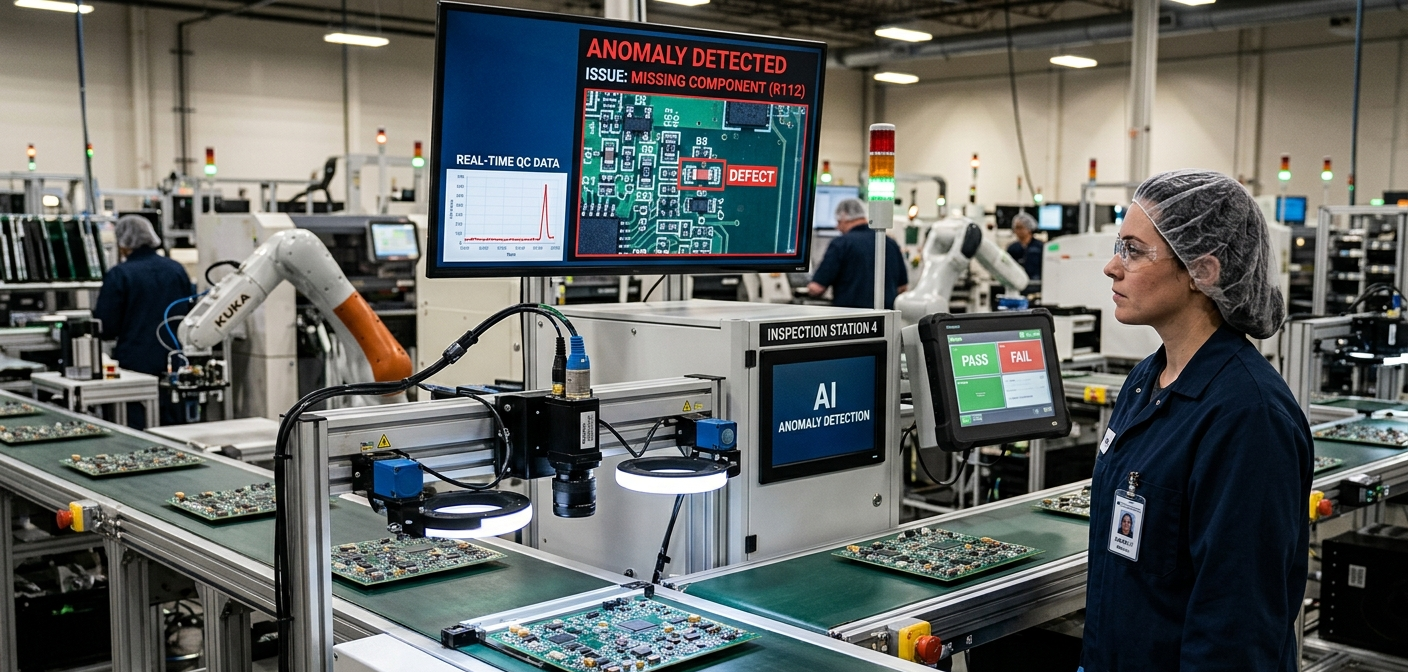
What Is Anomaly Detection?
At its core, anomaly detection is the process of identifying data points, patterns, or behaviors that deviate significantly from what is expected. In a manufacturing context, “expected” might mean the normal vibration signature of a conveyor motor, the typical temperature range of an injection mold, or the standard cycle time of a stamping press.
When something falls outside that expectation — even slightly — it’s flagged as an anomaly. Not every anomaly is a crisis. Some are noise. Some are the natural result of a shift change or a raw material substitution. But some are the early fingerprint of a bearing about to seize, a seal beginning to fail, or a calibration drifting out of spec.
The challenge, and the opportunity, is telling them apart.
Anomaly detection methods generally fall into three categories:
Statistical methods establish a baseline of normal behavior — mean, standard deviation, control limits — and flag observations that fall outside those bounds. These are fast, interpretable, and well-suited to stable, well-understood processes.
Machine learning methods learn the shape of normal behavior from historical data, without being explicitly told what “normal” looks like. Techniques like autoencoders, isolation forests, and one-class SVMs can detect complex, multivariate anomalies that no human engineer would think to write a rule for.
Time-series methods are purpose-built for sequential data — the kind that manufacturing produces in abundance. They account for trends, seasonality, and the way one reading relates to the readings before and after it. A temperature spike at minute 47 of every cycle is normal. The same spike at minute 12 is not.
Why Manufacturing Is Both the Hardest and the Most Rewarding Place to Apply It
Manufacturing environments are noisy — literally and figuratively. Sensors drift. Operators override settings. Recipes change. Seasonal humidity affects material behavior. Any anomaly detection system that doesn’t account for this context will drown production teams in false alarms until they stop paying attention to it altogether.
This is the failure mode we see most often when companies try to implement anomaly detection on their own: a technically correct model deployed into an operationally complex environment, with no feedback loop, no domain context baked in, and no way for the people on the floor to trust or interrogate its outputs.
But when it’s done well, the returns are extraordinary. Consider what’s at stake:
- Unplanned downtime costs manufacturers an average of hundreds of thousands of dollars per hour in lost production, expedited logistics, and labor disruption.
- Quality escapes — defects that make it to the customer — carry costs measured not just in dollars but in warranty claims, recalls, and reputation.
- Energy waste from equipment running outside optimal parameters is invisible without the right instrumentation and analysis.
- Safety incidents often have detectable precursors in process data that go unnoticed without a system designed to surface them.
Anomaly detection, properly implemented, addresses all four.
What a Real Solution Looks Like
Good anomaly detection in manufacturing isn’t a single algorithm. It’s a system — one that combines data infrastructure, domain expertise, model design, and operational integration.
Data infrastructure first. You cannot detect anomalies in data you don’t have. The foundation is reliable, high-frequency data collection from the right sensors and systems: PLCs, SCADA, MES, historian platforms, and increasingly, IIoT edge devices. The data must be timestamped accurately, cleaned consistently, and stored in a way that makes it accessible to analytics workflows.
Domain knowledge baked in. A model trained purely on data, without any understanding of the physical process, will produce anomalies that are statistically interesting but operationally meaningless. The best results come from close collaboration between data scientists and process engineers — people who know that a temperature reading of 340°F at startup is expected, while the same reading at steady-state is alarming.
Contextual, multivariate models. Modern manufacturing processes are not single-variable problems. A bearing doesn’t just get hot — it gets hot while vibrating at a particular frequency, while drawing a particular current, during a particular phase of the production cycle. Anomaly detection models need to reason across all of these dimensions simultaneously.
Tiered alerting and human-in-the-loop design. Not all anomalies require the same response. A tiered system — watch, warn, act — ensures that maintenance teams are notified at the right level of urgency, with enough lead time to plan rather than react. The goal is to support human decision-making, not replace it.
Continuous feedback and retraining. Processes evolve. New products are introduced. Equipment ages and is replaced. An anomaly detection system that was accurate 18 months ago may be producing stale results today. Sustainable programs include mechanisms for operators to provide feedback on alerts, and for models to be retrained as the process changes.
The Business Case in Plain Terms
We work with manufacturers who came to us after years of reactive maintenance — running equipment to failure and then scrambling to recover. In most cases, the data to have predicted those failures was already being collected. It just wasn’t being analyzed.
The economic case for anomaly detection typically rests on three levers:
- Downtime reduction through early warning of equipment degradation, enabling planned maintenance to replace unplanned stoppages.
- Quality improvement through detection of process drift before it produces out-of-spec product, reducing scrap, rework, and escapes.
- Asset life extension through operating equipment within optimal parameters and addressing issues before they cause secondary damage.
In our experience, manufacturers who implement well-designed anomaly detection programs see meaningful ROI within the first year — often recovering the full cost of implementation through a single avoided failure event.
Where to Start
The most common mistake is trying to boil the ocean. A facility with 200 assets and 10,000 sensor tags does not need to monitor all of them on day one.
Start with your highest-consequence, highest-frequency failure modes. Identify the assets whose failure is most costly, the failure modes that recur most often, and the sensors that are most likely to carry early warning signals. Build something that works and that the maintenance team trusts. Expand from there.
The goal is not to have the most sophisticated model. The goal is to have a working system that people use, that improves over time, and that makes the plant run better.
That’s what we build.
Interested in understanding what anomaly detection could look like for your facility? Reach out to our team for an initial conversation. We start every engagement with an honest assessment of where you are, what your data can support, and what the realistic opportunity looks like.