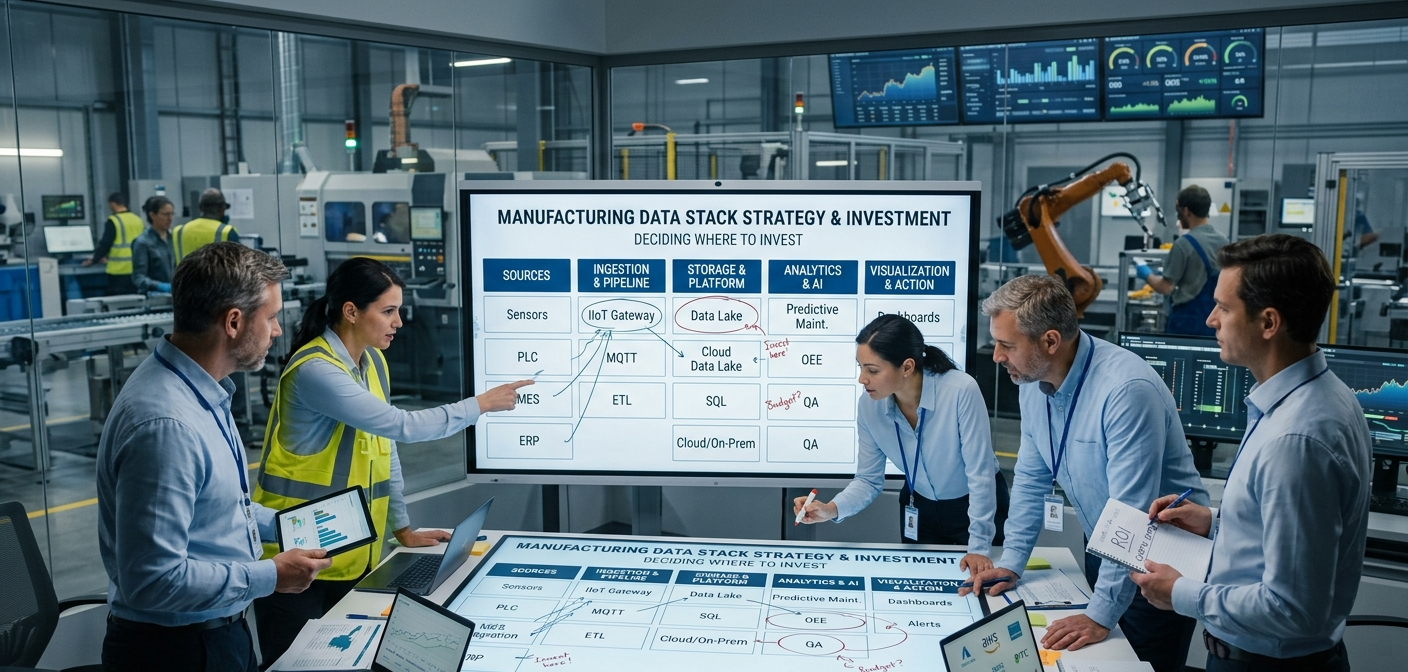
We’ve walked into a lot of plants over the years. Some are making aerospace components worth $40,000 a unit. Some are running high-volume food lines where a two-hour downtime costs more than most people’s annual salary. They look nothing alike on the surface. But when it comes to data investments, they almost always make the same mistakes in the same order.
The typical story goes like this: leadership attends a conference, sees a vendor demo with a stunning OEE dashboard pulling live machine data, and comes back energized. A six-figure software contract gets signed. Six months later, the dashboard exists — but it’s showing the wrong numbers, nobody trusts it, and the data team is drowning in support tickets about why Line 3’s output looks 40% lower than what operators actually recorded.
We call this the glamour-first problem. And fixing it is most of what we do.
The allure of the dashboard
Dashboards are visible. They’re demonstrable to a board. They create the feeling of progress. This is why they attract budget. But a dashboard is only as good as what feeds it, and in manufacturing environments, the data feeding most dashboards is a mess of manual entries, PLC exports with inconsistent timestamps, ERP records that don’t align with what actually shipped, and sensor streams that haven’t been validated since the equipment was installed.
We routinely audit plants where the OEE figure being reported is off by 15-25 percentage points from the true number — not because anyone is lying, but because downtime coding is inconsistent, changeover definitions vary by shift, and the system was never configured to handle split-batch scenarios. A beautiful dashboard displaying a wrong number isn’t an analytics asset. It’s a liability.
Where the money should actually go first
Before a single visualization, before a predictive model, manufacturers need to invest in three foundational layers that most vendors have no incentive to sell them: data capture integrity, semantic standardization, and a source-of-truth architecture.
Data capture integrity means ensuring that what gets recorded actually reflects what happened on the floor. This includes auditing PLC configurations, validating sensor calibration cadences, and — critically — working with operators to understand how and where manual overrides happen. If your shift supervisors are adjusting downtime codes after the fact to protect utilization numbers, no amount of tooling upstream will fix the downstream data quality.
Semantic standardization is the unglamorous work of deciding what words mean. What counts as a “planned stoppage” versus an “unplanned stoppage”? When does a changeover begin — when the last good part runs, or when the line stops? How is scrap distinguished from rework? These definitions need to be locked, documented, and enforced consistently across shifts, lines, and sites before you build anything on top of them.
A source-of-truth architecture means choosing where each metric officially lives and routing everything else to read from it, not compute its own version. In most plants, OEE is being calculated in three different systems using three different formulas. Until you designate a single authoritative source and enforce it, every report will conflict with every other report — and trust in analytics will erode faster than you can build it.
The ML trap
Predictive maintenance is perhaps the most oversold use case in manufacturing technology. The pitch is compelling: feed your sensor data into a model, and it will tell you when a bearing is about to fail before it takes the line down. In the right conditions, this works. But those conditions require years of clean, labeled historical data with reliable failure annotations — something almost no manufacturer actually has when they start the conversation.
We’ve seen companies spend $300,000 on a predictive maintenance platform and get a model that performs marginally worse than a maintenance engineer’s intuition, because the training data was a mix of labeled and unlabeled events, sensors had gaps during critical failure periods, and the model was trained on a machine configuration that changed 18 months ago.
This doesn’t mean ML has no place in manufacturing analytics. It absolutely does. But the right sequence is: build the data foundation, run descriptive analytics long enough to understand your baseline, use anomaly detection to flag deviations, and then layer in predictive models once you have the labeled history they need to learn from. Most manufacturers skip to the last step first.
Integration is not an IT problem
One of the most persistent misframings we encounter is treating system integration — connecting the MES to the ERP to the historian to the quality system — as a purely technical task to be handed off to IT. It isn’t. Integration decisions are business decisions about data ownership, update frequency, conflict resolution, and which system wins when two sources disagree.
When the production order in the ERP shows 5,000 units completed and the MES shows 4,847, someone needs to decide which number gets reported, why they differ, and how to prevent that discrepancy going forward. That’s not a question IT can answer alone. It requires operations, finance, and quality leadership in the room — and it needs to be answered before integration work begins, not after.
The right sequence
If we had to distill the correct investment sequence into a simple framework, it would look like this: start with data capture and governance (unglamorous, operator-facing, high-ROI), move to standardization and a clean data layer (the infrastructure everything else depends on), then build descriptive reporting (now your dashboards will mean something), then anomaly detection and alerting (actionable intelligence from clean data), and only then consider predictive and prescriptive analytics at scale.
This sequence takes longer than buying a platform. It requires internal change management. It doesn’t produce a demo-able artifact in week two. But it’s the only sequence that actually works — and manufacturers who follow it compound their analytics advantage year over year, while competitors are still rebooting failed implementations.
The data stack that wins is not the most advanced one. It’s the one that was built in the right order.
Getting Started with your Manufacturing Data Stack
Lasso works with discrete and process manufacturers on analytics strategy, data architecture, and operational performance improvement. Get in touch to get started on improving your manufacturing outcomes!