The Problem Isn't Speed — It's Blindness
Walk into any manufacturing operations meeting and you’ll hear variations of the same complaint: lead times are too long, customers are frustrated, and the production floor is always reacting to surprises. The instinct is usually to look inward — optimize scheduling, squeeze cycle times, reduce changeover. These are valuable improvements, but they address the wrong bottleneck.
In most manufacturing environments, the majority of lead time doesn’t live on your shop floor at all. It lives upstream — in supplier lead times, inbound logistics delays, material quality holds, and procurement cycles that start too late because no one saw the constraint coming.
Our work with mid-market and enterprise manufacturers across discrete, process, and mixed-mode environments consistently shows the same pattern: companies that have invested in upstream data visibility consistently outperform peers on lead time by 15–30%, not because they operate faster, but because they operate earlier.
What "Upstream Data Visibility" Actually Means
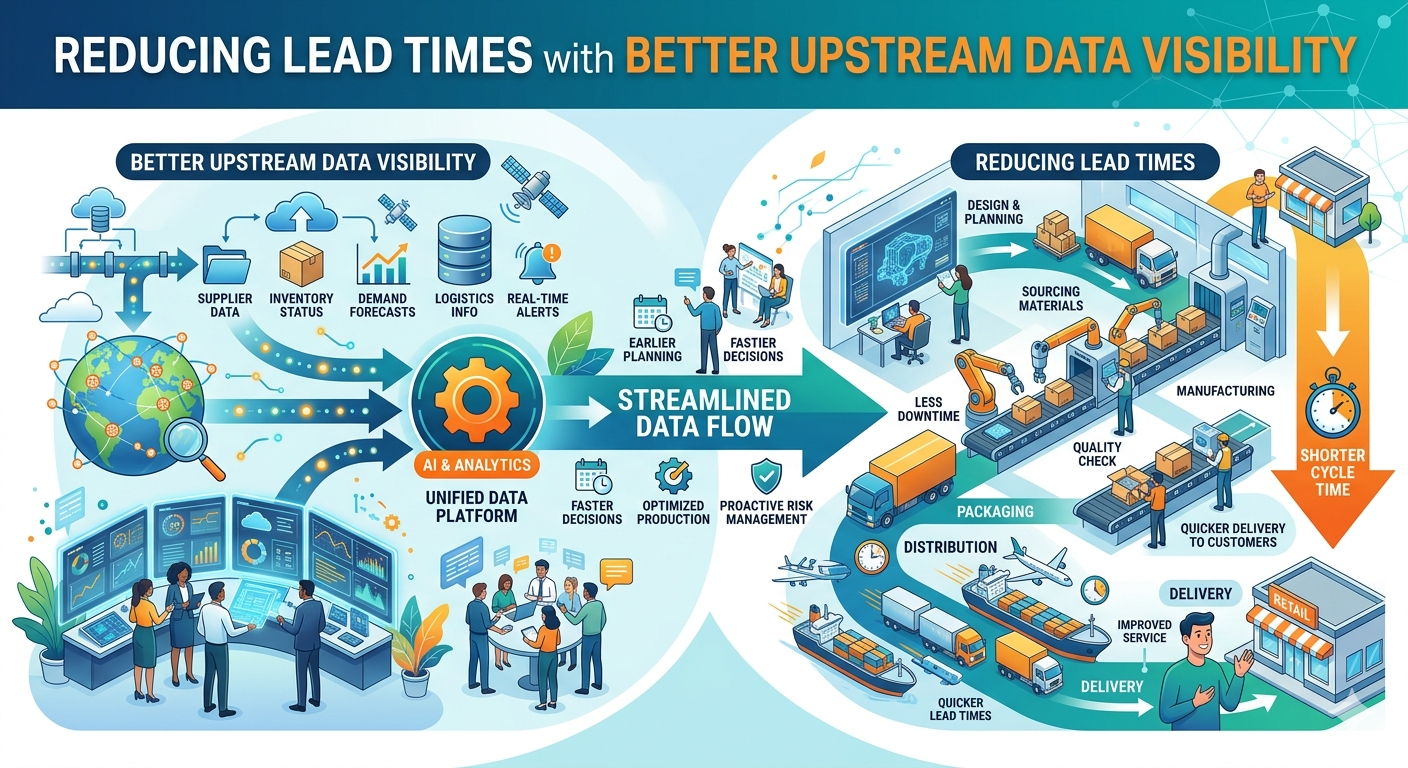
It’s a phrase that gets used loosely, so let’s be precise. Upstream data visibility is the ability to see — in near real time — the operational and logistical status of your supply chain before materials reach your dock. This includes:
The Upstream Visibility Stack
- Supplier production status — Are your key suppliers running on schedule? Are their own raw material supplies constrained?
- Inbound logistics tracking — Where is your inventory in transit, and are there delays at origin ports, customs, or regional hubs?
- Supplier quality signals — What’s the first-pass yield trend at your Tier 1 and Tier 2 suppliers? Is a quality problem brewing before it becomes a field issue?
- Capacity and allocation data — Are your suppliers over-allocated? Will a competitor’s surge order affect your allocation?
- Financial health indicators — Are any key suppliers showing stress signals that could compromise reliability?
Most manufacturers have some version of this data — buried in email threads, supplier portals, spreadsheets, and ERP transactions that arrive days or weeks after the fact. The gap isn’t data availability; it’s data latency and integration.
Why Data Latency Is a Lead Time Problem
Consider a common scenario: a Tier 1 supplier experiences a capacity constraint on a critical sub-assembly. Under typical information flows, your procurement team learns about this when the purchase order comes up short at receiving — often 6–8 weeks after the constraint first emerged. By then, your only options are expensive: expedite fees, airfreight, customer re-scheduling, or all three.
Now replay that scenario with upstream visibility in place. Your analytics platform flags an anomaly in the supplier’s confirmed-order-to-scheduled-ship ratio three weeks earlier. Your buyer reaches out proactively, confirms the constraint, and has time to qualify a secondary source, pull in an alternate PO, or adjust the production schedule before it becomes a customer problem.
Same constraint. Completely different outcome. The difference is measured in weeks and tens of thousands of dollars per incident.
This is why we tell clients that upstream visibility isn’t a procurement initiative or an IT project — it’s a lead time strategy.
Where High-Performing Manufacturers Start
The instinct is often to boil the ocean: connect to every supplier, ingest every data source, build a unified supply chain control tower. This approach consistently underdelivers in the first 18 months and erodes organizational confidence in the initiative.
The manufacturers we’ve seen get the fastest results start with a more targeted question: where does lead time variance actually come from?
For most clients, a Pareto analysis of delivery variance reveals that ~20% of supplier relationships or material categories account for 70–80% of lead time unpredictability. Starting upstream visibility efforts with those specific suppliers — even with manual or semi-structured data collection — delivers measurable impact quickly and builds the business case for broader investment.
The Integration Hierarchy: From Manual to Machine
One of the most common misconceptions is that upstream visibility requires all suppliers to have sophisticated EDI or API capabilities. In practice, the most effective programs layer multiple integration approaches based on supplier maturity and strategic importance.
Integration Tier Model
- Tier A – Strategic / High-Risk Suppliers: Direct API or EDI integration with production scheduling systems; automated exception alerting; weekly structured data review cadences.
- Tier B – Important / Moderate-Risk: Supplier portal submissions with structured templates; automated parsing into the analytics platform; monthly performance dashboards shared back to suppliers.
- Tier C – Standard / Lower-Risk: Standardized email reporting templates; NLP-assisted extraction; quarterly reviews. Low overhead, meaningful signal improvement.
This tiered approach means manufacturers don’t need to wait for a multi-year systems transformation to get started. A mid-market manufacturer we worked with in the industrial components space stood up meaningful upstream visibility for their top 15 suppliers in 11 weeks — using a combination of a lightweight supplier portal, structured weekly check-in templates, and a simple analytics layer in their existing BI environment. Lead time variance on those materials dropped 31% within six months.
Turning Raw Data into Lead Time Leverage
Collecting upstream data is necessary but not sufficient. The analytics layer is where the operational value is created. Three analytical capabilities consistently drive the most impact:
1. Lead Time Signal Modeling: Building predictive models that translate upstream signals (supplier capacity utilization, inbound transit deviations, quality hold rates) into probabilistic lead time forecasts by material and supplier. This allows procurement and planning to work with distributions, not just averages — and to set safety stock and production buffers that actually reflect real uncertainty rather than historical averages with a fudge factor.
2. Constraint Propagation Analysis: When a supplier signals a constraint, the impact isn’t isolated. Analytics that can trace material dependencies and flag downstream production sequences that will be affected — before the shortage hits — give planners hours or days to reroute, resequence, or substitute. The manufacturers doing this well have effectively eliminated the “surprise expedite.”
3. Supplier Reliability Scoring: Dynamic, data-driven supplier scorecards that reflect current performance (not last quarter’s) and incorporate leading indicators — not just lagging ones. When sourcing decisions include reliability scores built from real-time upstream data, the quality of the supply base improves over time, compounding the lead time benefit.
The Organizational Dimension: Data Doesn't Act — People Do
We’d be doing clients a disservice if we framed upstream visibility as purely a technology problem. The manufacturers that realize the full lead time benefit combine data capability with clear process ownership and response protocols.
Specifically: who is responsible for monitoring upstream signals? What’s the escalation path when an anomaly is detected? What decision rights does that person have — can they pull in a purchase order, authorize a spot buy, or adjust a production sequence without a two-week approval cycle?
The speed of the organization’s response to upstream signals is often the binding constraint — not the quality of the data. This is why we build process design work into every upstream visibility engagement, not just the analytics architecture.
What Results Actually Look Like
Across our client base, manufacturers with mature upstream visibility programs — meaning integrated data, analytics, and response processes — show consistent patterns:
Lead time reduction of 15–30% on the materials categories where visibility is implemented. Expedite spend reductions of 35–50%, often in the first year. Improved customer on-time delivery, which in many cases directly supports pricing power and contract renewal rates. And perhaps less obvious: better supplier relationships. Suppliers consistently report that structured visibility programs make them better partners — the data-sharing creates accountability on both sides and reduces the adversarial dynamic that characterizes many customer-supplier conversations about delivery performance.
Getting Started: Three Questions to Ask This Week
If your organization is considering an upstream visibility initiative — or trying to revive one that stalled — start with these three diagnostic questions:
Where does our lead time variance actually come from? Not anecdotally — analytically. Pull the last 12 months of receiving data and categorize late deliveries by cause and supplier. The answer will likely surprise you and will immediately focus the initiative.
What data do we already have that we’re not using? Most manufacturers have more upstream signal in their existing systems than they realize — PO confirmation patterns, freight forwarder data, supplier portal logins, quality hold records. An inventory of existing data often reveals quick wins before any new integration is needed.
Who owns the response, not just the data? Identify the person or team who will act on upstream signals before you build the capability to generate them. Without a clear owner and defined response protocols, even excellent data creates no lead time improvement.
The manufacturers gaining durable competitive advantage on lead time aren’t doing so through heroic operational intensity. They’re doing it by seeing their supply chain clearly — far enough upstream to act before constraints become crises. That capability is more achievable, and more impactful, than most operations leaders expect.