


Purchase Requisition vs. Purchase Order: Understanding the Key Differences

Procurement can seem like a world full of jargon — and two terms that often cause confusion are purchase requisition (PR) and purchase order (PO). Although they sound similar and are closely linked in the purchasing process, they serve very different purposes and occur at different stages. Whether you’re a business owner, a procurement professional, or just curious about how organizations manage their purchasing, this blog post will break down the differences between a PO requisition and a purchase order, their roles, and why they matter.

What is a Purchase Requisition?

A Purchase requisition (or PO Requisition) is an internal document created within an organization to request the purchase of goods or services. It’s essentially the first step in the procurement process, where an employee or department identifies a need and seeks approval to move forward with acquiring it.

Key Features of a Purchase Requisition:

  • Internal Request: A PO requisition is used within the organization and is not sent to suppliers or vendors.
  • Approval Process: It typically requires approval from a manager or the finance department to ensure the purchase aligns with the budget and organizational needs.
  • Details Included: It outlines what is needed, including item descriptions, quantities, estimated costs, and the reason for the purchase.
  • Non-Binding: A Purchase requisition does not commit the organization to a purchase; it’s a preliminary step to gain authorization.


For example, imagine an office manager notices the team is running low on printer paper. They’d create a purchase requisition detailing the type and quantity of paper needed, submit it to their supervisor for approval, and wait for the green light to proceed.

What is a Purchase Order?

A purchase order (PO) is a formal, legally binding document issued by a buyer (the organization) to a seller (the supplier or vendor) to confirm the purchase of goods or services. It’s created after the PO requisition has been approved and serves as an official agreement between the buyer and seller.

Key Features of a Purchase Order:

  • External Document: A purchase order is sent to the supplier to place the order.
  • Binding Agreement: Once accepted by the supplier, it becomes a contract that outlines the terms of the sale, including price, delivery dates, and payment terms.
  • Specific Details: It includes precise information like item descriptions, quantities, agreed-upon prices, shipping instructions, and terms of delivery.
  • Tracks the Transaction: A PO helps both parties track the order, ensuring what’s delivered matches what was ordered.


Using the same example, once the office manager’s PO requisition for printer paper is approved, the procurement team would issue a purchase order to the office supply vendor, specifying the exact type of paper, quantity, price, and delivery date.

Key Differences Between a Purchase Requisition and a Purchase Order

To make things clearer, let’s compare the two side by side:
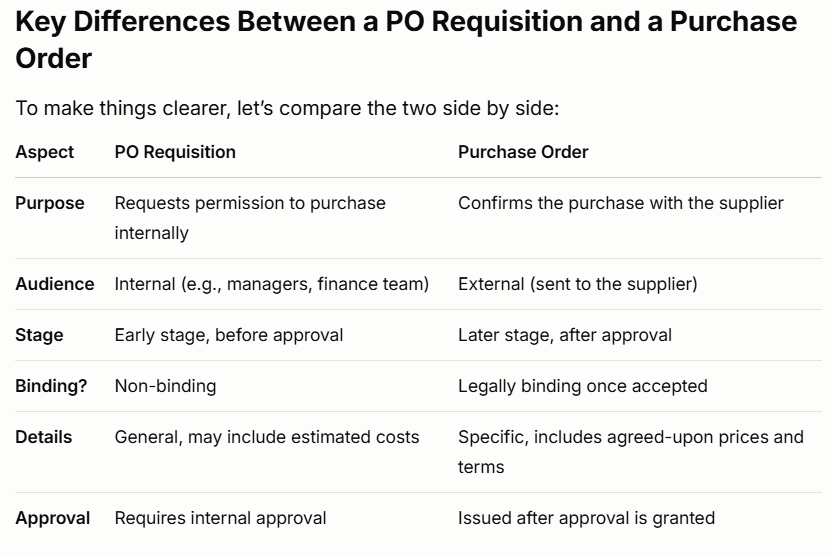
differences between purchase requisitions and purchase orders

Why the Distinction Matters

Understanding the difference between a purchase requisition and a purchase order is crucial for streamlining procurement processes and maintaining financial control. Here’s why:

  1. Budget Management: PO requisitions ensure that purchases are vetted and approved before any money is committed, preventing overspending or unauthorized purchases.
  2. Clear Communication: Purchase orders provide suppliers with precise instructions, reducing the risk of errors in delivery or pricing.
  3. Audit Trail: Both documents create a paper trail, which is essential for tracking purchases, resolving disputes, and conducting audits.
  4. Efficiency: Separating the request (requisition) from the order (PO) allows organizations to maintain a structured workflow, especially in larger companies with multiple departments.

Common Misconceptions

  • They’re the Same Thing: Some people assume a PO requisition and a purchase order are identical, but as we’ve seen, they serve different purposes at different stages.
  • Only Large Companies Use Them: While formal procurement processes are common in big organizations, small businesses can also benefit from using requisitions and POs to manage spending and maintain clear vendor relationships.
  • PO Requisitions Are Unnecessary: Skipping the requisition step might seem faster, but it can lead to unapproved purchases, budget overruns, or misaligned priorities.

When to Use Each

  • Use a PO Requisition when you need to request approval for a purchase within your organization. This is ideal for ensuring the purchase is necessary, budgeted, and aligned with company goals.
  • Use a Purchase Order when you’re ready to place an order with a supplier. It formalizes the transaction and ensures both parties are on the same page.

How Data Analytics Unlocks Insights from Purchase Requisitions and Purchase Orders

Purchase requisitions (PRs) and purchase orders (POs) generate a wealth of data—but in many SMB manufacturing environments, that data goes underutilized. By applying analytics to PR and PO data, organizations can gain powerful insights into spending behavior, process efficiency, and supplier performance.

Spend Visibility and Control
Analyzing PO data provides a clear picture of where money is actually being spent—by supplier, category, department, and time period. When paired with PR data, you can also understand demand before it becomes committed spend, helping to:

  • Identify unnecessary or duplicate purchases early
  • Track budget adherence from request to final order
  • Reduce maverick or off-contract spending

This creates tighter financial control and more proactive procurement management.

Process Efficiency and Cycle Time Analysis
PR-to-PO cycle time is a critical metric that often goes unmeasured. Analytics can break down each stage of the process:

  • Time from requisition creation to approval
  • Approval bottlenecks by department or approver
  • Time from approval to PO issuance

This helps uncover inefficiencies—such as delayed approvals or manual handoffs—that slow down procurement and impact operations.

Approval and Compliance Insights
By analyzing requisition and approval data, organizations can ensure procurement policies are being followed. For example:

  • Are purchases being approved at the correct authority levels?
  • Are there patterns of requisitions bypassing standard workflows?
  • How often are emergency or last-minute requests occurring?

These insights strengthen governance and reduce risk.

Demand Planning and Forecasting
PR data is especially valuable because it represents early demand signals. By aggregating and analyzing requisition trends over time, manufacturers can:

  • Forecast future purchasing needs more accurately
  • Align procurement with production planning
  • Anticipate demand spikes or seasonality

This enables a more proactive and strategic approach to sourcing.

Supplier Performance and Order Accuracy
PO data can be used to evaluate how well suppliers are meeting expectations:

  • On-time delivery vs. promised dates
  • Order accuracy (quantities, pricing, specifications)
  • Frequency of changes or discrepancies

Linking this back to requisition data also helps assess how well internal requirements are being translated into external orders—reducing errors and rework.

How Lasso Data Analytics Helps SMB Manufacturers Leverage PR and PO Data

For SMB manufacturers, PR and PO data is often scattered across ERP systems, spreadsheets, and email threads—making it difficult to extract meaningful insights. Lasso’s data analytics consulting services help turn this fragmented data into a structured, actionable asset.

Strategy: Identifying High-Impact Use Cases
Lasso begins by working with your team to identify where PR and PO analytics can drive the most value. This includes:

  • Assessing current procurement workflows and data availability
  • Defining key metrics such as cycle time, approval rates, spend under management, and supplier performance
  • Prioritizing use cases like spend visibility, process optimization, or compliance tracking

The focus is on aligning analytics initiatives with real operational pain points and business goals.

Implementation: Building a Unified Data and Analytics Layer
Lasso helps consolidate and transform your procurement data into usable insights:

  • Integrating PR and PO data from ERP systems, procurement tools, and manual sources
  • Cleaning and standardizing data for consistency and accuracy
  • Developing dashboards that track spend, cycle times, approvals, and supplier performance
  • Creating automated reporting and alerts for bottlenecks or policy violations

These solutions are designed to fit into existing SMB environments—without requiring large-scale system overhauls.

Support: Driving Adoption and Continuous Improvement
Beyond implementation, Lasso ensures your team can effectively use and evolve these analytics capabilities:

  • Training procurement, finance, and operations teams on dashboards and insights
  • Continuously refining metrics and models as processes mature
  • Identifying new opportunities to optimize procurement based on data trends
  • Providing ongoing analytics and data engineering support as your needs grow

With Lasso’s support, SMB manufacturers can move from reactive, manual procurement processes to a more streamlined, data-driven approach—improving speed, control, and decision-making across the entire PR-to-PO lifecycle.


By leveraging analytics across purchase requisitions and purchase orders, organizations gain end-to-end visibility into both demand and execution—unlocking opportunities to reduce costs, improve efficiency, and strengthen supplier performance.

You might also like

  • All Posts
  • Cloud Data Infrastructure
  • Cloud Web Applications
  • Digital Manufacturing Strategy
  • Implementation & Best Practices
  • Manufacturing Industry Insights
  • Operations Analytics
  • Supply Chain Management

Table of Contents

Data Analytics for SMB Manufacturers

Contact Us

contact@lassosupplychain.com