
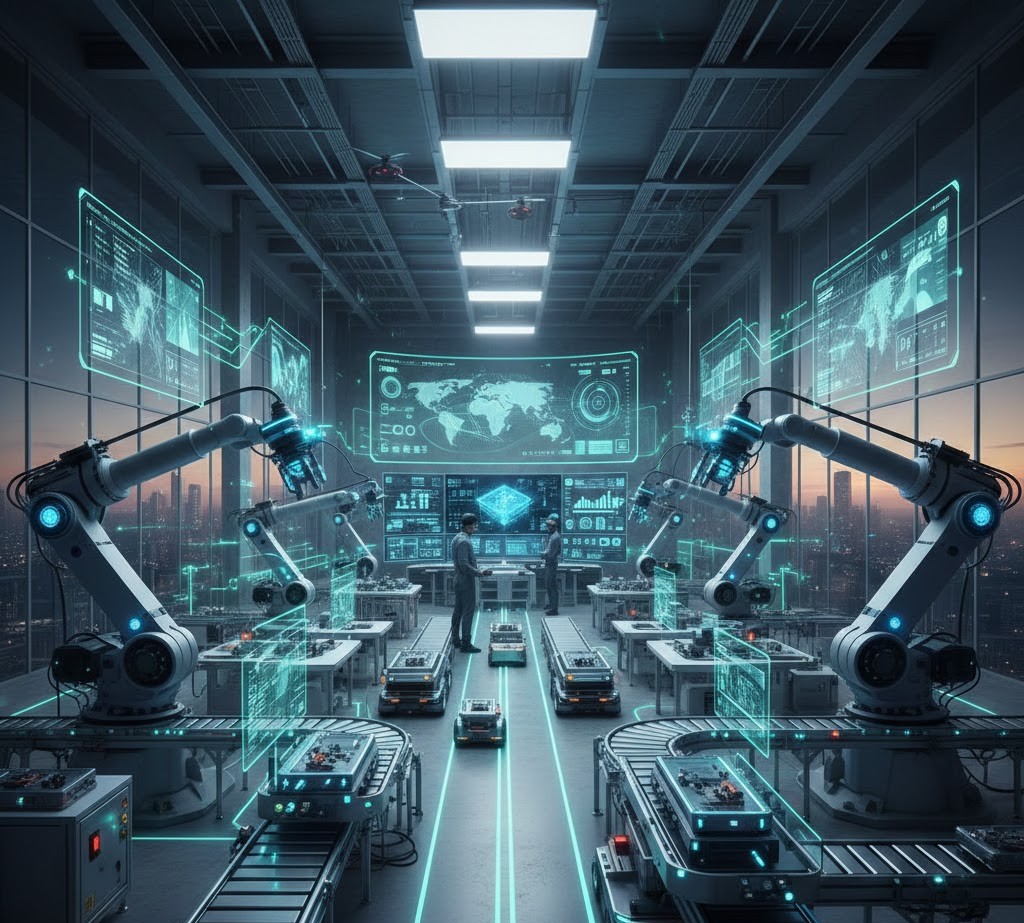
The Importance of Investing in Smart Manufacturing Technologies
Manufacturers face unprecedented challenges from global supply chain disruptions, labor shortages, and ever present competitive pressures to deliver higher quality, faster lead times, for a lower price. Investing in technology is a strategic imperative for survival and growth. By adopting cutting-edge tools like AI, advanced analytics, cloud computing, automation, and IoT, manufacturers can enhance operational efficiency, reduce costs, and unlock new revenue streams. These investments not only streamline production processes but also foster innovation, allowing companies to respond swiftly to market changes and customer needs.
One key benefit is improved competitiveness and agility. For instance, smart manufacturing processes powered by AI and data analytics help firms manage vast amounts of data securely, turning insights into actionable strategies that outpace competitors. Additionally, automation addresses labor costs and errors, future-proofing operations against workforce gaps.
Top Areas Manufacturers are Making Investments
In a survey conducted by Deloitte, 600 manufacturers were asked “What do you plan to prioritize investing in within the next 24 months?”

Factory Automation Hardware
Factory automation hardware encompasses the physical components and systems designed to automate manufacturing processes, including robots, sensors, programmable logic controllers (PLCs), conveyor systems, and hydraulic or pneumatic machinery. These elements integrate to control and optimize production lines with minimal human intervention, forming the backbone of modern smart factories. Essentially, it transforms traditional manual operations into efficient, data-driven workflows, enabling real-time monitoring and adjustments for enhanced productivity.
Primarily, it boosts efficiency and productivity by automating repetitive tasks, allowing for faster production cycles and higher throughput while reducing operational downtime. Cost savings are another key advantage, achieved through lower labor expenses, minimized material waste, and optimized energy use. Quality and consistency improve as automated systems ensure precise control, reducing defects and human errors for more reliable outputs.
Safety is greatly enhanced, as hazardous tasks are delegated to machines, creating a safer work environment and lowering injury risks. Additionally, factory automation hardware provides scalability and flexibility, enabling manufacturers to adapt quickly to market demands or product changes without extensive reconfiguration. In an era of supply chain volatility, these technologies foster resilience, better inventory management, and data-driven decision-making, positioning manufacturers for long-term competitiveness.
Data Analytics
Data analytics in manufacturing refers to the systematic collection, processing, and analysis of data generated from production processes, machinery, supply chains, and operations to derive actionable insights. It leverages technologies like machine learning, big data tools, and IoT sensors to monitor performance, predict issues, and optimize workflows in real-time.
Operational efficiency is enhanced by identifying bottlenecks, reducing downtime through predictive maintenance, and streamlining supply chain management, which can lead to significant cost savings and improved resource utilization. For instance, real-time data access allows for immediate adjustments, boosting productivity and forecasting accuracy. Secondly, it drives innovation and quality control by providing insights into customer behavior, enabling tailored production and minimizing defects. In 2025, with advancements in platforms like AI-integrated analytics, manufacturers can achieve greater visibility across operations, from inventory to demand forecasting, fostering resilience amid economic uncertainties. Overall, embracing data analytics positions manufacturers for sustainable growth, competitive advantage, and alignment with ESG goals through optimized, data-driven strategies.
Advanced Production Scheduling
Advanced Production Scheduling (APS) is a sophisticated digital solution that optimizes the allocation of raw materials, production capacity, and resources to meet demand efficiently. It integrates with technologies like AI, IoT, and real-time data analytics to create dynamic schedules that account for constraints such as machine availability, labor shifts, and supply chain variability. Unlike traditional methods, APS handles complex trade-offs in volatile environments, enabling finite capacity planning and scenario simulations for better decision-making.
The benefits to manufacturers are substantial, driving investments in this area. APS enhances operational efficiency by minimizing downtime, reducing lead times, and improving on-time delivery rates, which can boost customer satisfaction and revenue. It also optimizes resource utilization, cutting costs through better inventory management and waste reduction while increasing overall productivity and profitability. Furthermore, by providing real-time visibility and predictive capabilities, APS fosters agility, allowing manufacturers to respond swiftly to market changes, supply disruptions, or demand fluctuations, positioning them for competitive advantage in a fast-paced global landscape.
Quality Management
Quality management technology encompasses digital tools, software systems, and integrated platforms designed to oversee, monitor, and enhance product quality across manufacturing operations. In the context of manufacturing, it includes Quality Management Systems (QMS) software that leverages AI, machine learning, IoT, and data analytics for real-time defect detection, process optimization, and compliance tracking. These technologies align with Industry 4.0 principles, enabling predictive quality control and integration with supply chain and production workflows to ensure consistent standards. In 2025, advancements like agentic AI and immersive AR/VR for inspections and training are transforming traditional quality assurance into proactive, data-driven strategies.
The benefits to manufacturers are extensive, making it a key investment area. It significantly reduces defects and rework through predictive analytics, potentially cutting quality failures by up to 30%, which minimizes scrap, warranty claims, and reputational risks. Cost efficiencies arise from optimized processes, lower downtime, and better resource utilization, while ensuring regulatory compliance and alignment with ESG goals through sustainable practices and risk-based thinking. Additionally, it fosters innovation by providing real-time insights, improving employee training via immersive tech, and enhancing overall operational resilience in volatile markets. By elevating quality management, manufacturers can achieve higher customer satisfaction, competitive advantage, and long-term profitability in an increasingly complex global landscape.
Active Sensors
Active sensors are devices that emit their own energy signal—such as light, sound, or electromagnetic waves—and measure the response or reflection from the target object or environment to gather data. These sensors play a pivotal role in smart manufacturing initiatives, integrating with IoT systems for real-time monitoring, object detection, and process control on production lines. Examples include ultrasonic sensors for distance measurement, laser scanners for quality inspection, and radar-based systems for material handling, which actively probe the surroundings unlike passive sensors that rely on ambient energy.
The benefits to manufacturers are substantial, driving investments in this technology. Active sensors improve precision and reliability in harsh environments, enabling accurate detection even in low-visibility conditions, which reduces errors and enhances product quality. They boost operational efficiency through predictive maintenance, minimizing downtime by monitoring equipment health in real-time, and support safety by detecting hazards or anomalies proactively. Additionally, by facilitating data collection for analytics, active sensors contribute to waste reduction, energy optimization, and overall supply chain resilience, positioning manufacturers for competitive advantages in dynamic markets.
Execution System
Execution systems, commonly referred to as Manufacturing Execution Systems (MES), are specialized software platforms that monitor, track, document, and control the transformation of raw materials into finished goods on the factory floor. In the manufacturing context, MES bridges the gap between enterprise resource planning (ERP) systems and shop-floor operations, providing real-time data on production status, equipment performance, and workflow efficiency to ensure seamless execution of manufacturing processes. As of 2025, MES technologies are evolving with integrations like AI, IoT, and cloud computing, enabling smarter, more adaptive manufacturing environments.
The benefits to manufacturers are compelling, making MES a critical investment area. It enhances operational efficiency by providing real-time visibility, reducing production downtime, and optimizing resource allocation, which can lead to significant cost savings and faster time-to-market. Quality and compliance improve through detailed traceability, automated inspections, and data-driven decision-making, minimizing defects, waste, and regulatory risks. Furthermore, MES fosters agility in volatile markets by enabling quick adjustments to schedules, better inventory management, and integration with supply chains, ultimately driving higher productivity, profitability, and competitiveness for manufacturers.
Cloud Computing
Cloud computing refers to the delivery of on-demand computing services—such as storage, processing power, databases, and software—over the internet, allowing users to access and scale resources without owning physical infrastructure. In the manufacturing context, it integrates with Industry 4.0 technologies like IoT, AI, and big data to enable smart factories, real-time collaboration, and data-driven operations. For small and medium-sized businesses (SMBs) in manufacturing, cloud solutions are particularly transformative, offering affordable entry points to advanced tools that were once reserved for large enterprises. In 2025, with trends like hybrid and multi-cloud adoption, SMB manufacturers can leverage platforms for everything from ERP systems to supply chain visibility, without hefty upfront investments.
SMB manufacturers can use cloud computing in various ways to streamline operations. For instance, cloud-based ERP and MES systems facilitate inventory management, production scheduling, and quality control, enabling real-time data access from anywhere. IoT integration allows for predictive maintenance by monitoring equipment remotely, while AI-driven analytics provide insights into demand forecasting and process optimization. Collaboration tools support global supply chains, and scalable storage handles growing data volumes from sensors and machines, all on a pay-as-you-go model that fits SMB budgets.
Artificial Intelligence & Machine Learning
Artificial Intelligence (AI) and Machine Learning (ML) in manufacturing involve algorithms and systems that enable machines to learn from data, make predictions, and automate decision-making processes. For small and medium-sized businesses (SMBs), these technologies democratize advanced capabilities through accessible tools like no-code platforms and cloud-based solutions, allowing even resource-limited firms to integrate smart systems without extensive expertise. In 2025, with trends like agentic AI and automated ML (AutoML), SMB manufacturers can leverage these for real-time optimization in production lines, aligning with Industry 4.0 while addressing challenges like labor shortages and supply chain volatility.
SMB manufacturers can apply AI and ML in practical ways to enhance operations. For predictive maintenance, ML models analyze sensor data to forecast equipment failures, reducing unplanned downtime by up to 50%. Quality control benefits from AI-driven vision systems that detect defects in real-time, improving accuracy and minimizing waste. Supply chain optimization uses ML for demand forecasting and inventory management, enabling agile responses to market changes. Additionally, process automation through hyperautomation combines AI with robotic tools for efficient workflows, while sustainability applications optimize energy use and support circular economy practices.
Vision Systems
Vision systems, also known as machine vision systems, are advanced technologies that enable machines to interpret and understand visual information from the physical world, much like human vision but with greater speed, accuracy, and consistency. In the manufacturing context, these systems integrate cameras, sensors, lighting, and sophisticated software algorithms—often powered by AI and machine learning—to capture, process, and analyze images in real-time for automated decision-making. As of 2025, vision systems are evolving with innovations like hyperspectral imaging and self-supervised learning, making them essential for smart factories in Industry 4.0 and beyond.
Manufacturers, including SMBs, can utilize vision systems for a variety of applications to enhance operations. Common uses include automated inspection for defect detection, precise measurement and gauging of parts, guidance for robotic assembly, barcode reading for tracking, and even predictive maintenance by monitoring equipment wear. For instance, in high-mix environments, systems like those from Keyence or Elementary allow quick setup and adaptation to new products without extensive expertise, supporting tasks from quality control in pharmaceuticals to sorting in logistics.
Internet of Things
The Internet of Things (IoT) in manufacturing involves interconnected devices, sensors, and systems that collect and exchange data in real-time to optimize operations, often integrated with AI for enhanced intelligence (AIoT). For small and medium-sized businesses (SMBs), IoT offers accessible, scalable solutions through cloud platforms, enabling even resource-constrained manufacturers to deploy sensors for monitoring equipment, supply chains, and production floors without massive upfront costs. In 2025, with advancements in affordable IoT hardware and software, SMBs are increasingly adopting these technologies to align with Industry 4.0, focusing on areas like smart factories and predictive analytics amid economic pressures.
SMB manufacturers can leverage IoT in practical applications tailored to their needs. For instance, deploying sensors for predictive maintenance detects equipment issues before failures, while inventory tracking systems automate stock management to prevent shortages or overstocking. Energy monitoring optimizes usage for cost savings, and supply chain integration provides real-time visibility into suppliers and logistics, fostering collaboration. Cloud-based IoT platforms make implementation straightforward, allowing SMBs to start small with pilot projects in areas like quality control or worker safety monitoring.
Leveraging Manufacturing Technology in your business
Small and medium-sized business (SMB) manufacturers often face barriers to adopting advanced technologies due to limited resources and expertise, but partnering with specialized providers like Lasso can streamline the process significantly. Lasso offers custom web-based software tailored for SMBs, starting with consultations to identify operational pain points and then developing iterative solutions for procurement, supplier management, and real-time analytics, enabling seamless integration of technologies such as IoT sensors, AI-driven analytics, and cloud-based execution systems. This partnership model not only reduces complexity and costs compared to off-the-shelf systems but also provides centralized data access for monitoring technology performance, fostering agile adoption of innovations like advanced production scheduling or quality management tech to boost efficiency, resilience, and competitiveness in dynamic markets.
Lasso – Your Technology Partner
Lasso is a software development agency created to bring your custom software project to reality with our simple process:
Initial Consultation
Scope & Estimate
Milestone Deliverables
Ownership Transfer
Service & Support
Sound interesting? Let’s get in touch so we can discuss your project!


