
Case Study
Transforming Decision-Making at A Mid-Sized Precision Manufacturer Through Integrated Executive Dashboards
- Home
- /
- Case Studies
- /
- Case Study: Transforming Decision-Making at A Mid-Sized Precision Manufacturer Through Integrated Executive Dashboards
Client Overview
A Manufacturer of precision-engineered components for the automotive and aerospace industries based in the Midwest US, produces high-volume parts with tight tolerances. With a workforce of over 170, the company operates multiple production lines across two facilities. However, as the manufacturer grew, management struggled to align factory floor operations with broader financial and strategic goals. Manual reporting processes dominated, relying on spreadsheets compiled from disparate systems like ERP (Enterprise Resource Planning) for financials, MES (Manufacturing Execution System) for production, and manual logs for quality checks.
Problem
The leadership team faced siloed and inconsistent data that disconnected real-time factory floor KPIs—such as Overall Equipment Effectiveness (OEE), defect rates, and on-time delivery—from operational metrics (e.g., inventory turnover), financial indicators (e.g., cost per unit, cash flow), and strategic objectives (e.g., profitability, revenue growth). Key challenges included:
Poor Data Quality: Pre-engagement, data was scattered across multiple source systems without a consistent, standardized structure. Conflicting numbers for the same KPI were reported depending on the report, system, or person asked.
Timeliness Issues: Time lags between when activity occurred on the factory floor and when it showed up in reports. Data was often seriously outdated by the time it was reviewed.
Manual Reporting Burden: Reporting depended heavily on manual spreadsheet manipulation to compensate for missing, inconsistent, or poorly structured source data.
The leadership team wanted one clear, reliable view of the business that tied operational performance directly to financial results and strategic goals — without adding headcount or replacing their ERP and MES systems.
Solution
Lasso designed and delivered a centralized executive dashboard framework that leveraged a modern analytics resource stack to connect factory floor data to operational, financial, and strategic KPIs.
Standardizing and Improving Data Quality: We began by aligning leadership on a single KPI definition framework, ensuring consistency across departments.
Defined standardized metrics for OEE, scrap rate, throughput, labor efficiency, and on-time delivery
Validated data at the source (ERP, MES, quality systems)
Implemented automated data quality checks to flag and handle missing or anomalous values
Automating Manual Reporting: We replaced spreadsheet-driven reporting with automated data pipelines:
Hourly and daily data refreshes from production and ERP systems
Automated calculations for operational and financial KPIs
Removal of manual data preparation and reconciliation
What previously took multiple people several days per month became a fully automated process.
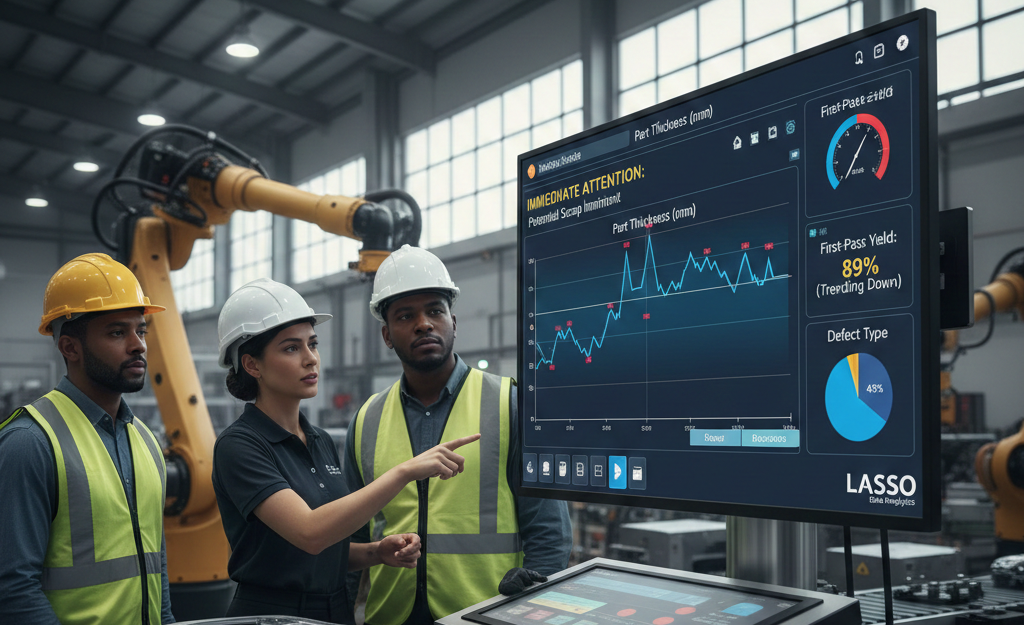
Executive Dashboards That Connect Operations to Financials: We delivered role-based dashboards designed specifically for executive decision-making.
Factory Floor → Financial Impact Mapping
Scrap and rework tied directly to cost of poor quality
Downtime translated into lost production and revenue impact
Labor efficiency linked to margin performance
Dashboard Views Included:
Real-time operational performance by plant and line
Financial rollups showing how operational variances affect margins
Trend analysis to support strategic planning and capital decisions
Executives could now move seamlessly from “What happened on the floor?” to “What does this mean for the business?”
This solution bridged the gap between granular operational data and high-level strategy, creating a “single source of truth” for decision-making.
Outcomes
The executive dashboards delivered measurable improvements, empowering managers to make proactive, data-driven decisions:
Improved Visibility into KPIs: Going from “feelings” to trusted data-driven decisions.
Improved Trust in Data across Departments: No more inconsistencies and second-guessing the data, allowing the leadership team to focus on taking actions to improve their operations.
Faster Decision Making: Moving from multiple weeks to same day updates helped accelerate decision making. The company was able to quickly home in on problems and take action to address them.
Automation of Manual Tasks: Eliminated over 90% of time spent preparing data for management review, freeing up administrative hours for strategic initiatives.
Business Impact: Measured improvements across equipment effectiveness, defect rates, and on-time delivery contributing to reduced costs and ability to revamp revenue growth activities.
This case study illustrates how targeted dashboard implementations can transform SMB manufacturers from reactive operations to strategic agility, emphasizing the ROI of investing in data quality and automation.
Proven Results
Lasso Case Studies


Turn Your Data Into Better Decisions
Get in touch with our team of data and AI experts to learn how our end-to-end solutions can empower your business to make smarter, data-driven decisions.
